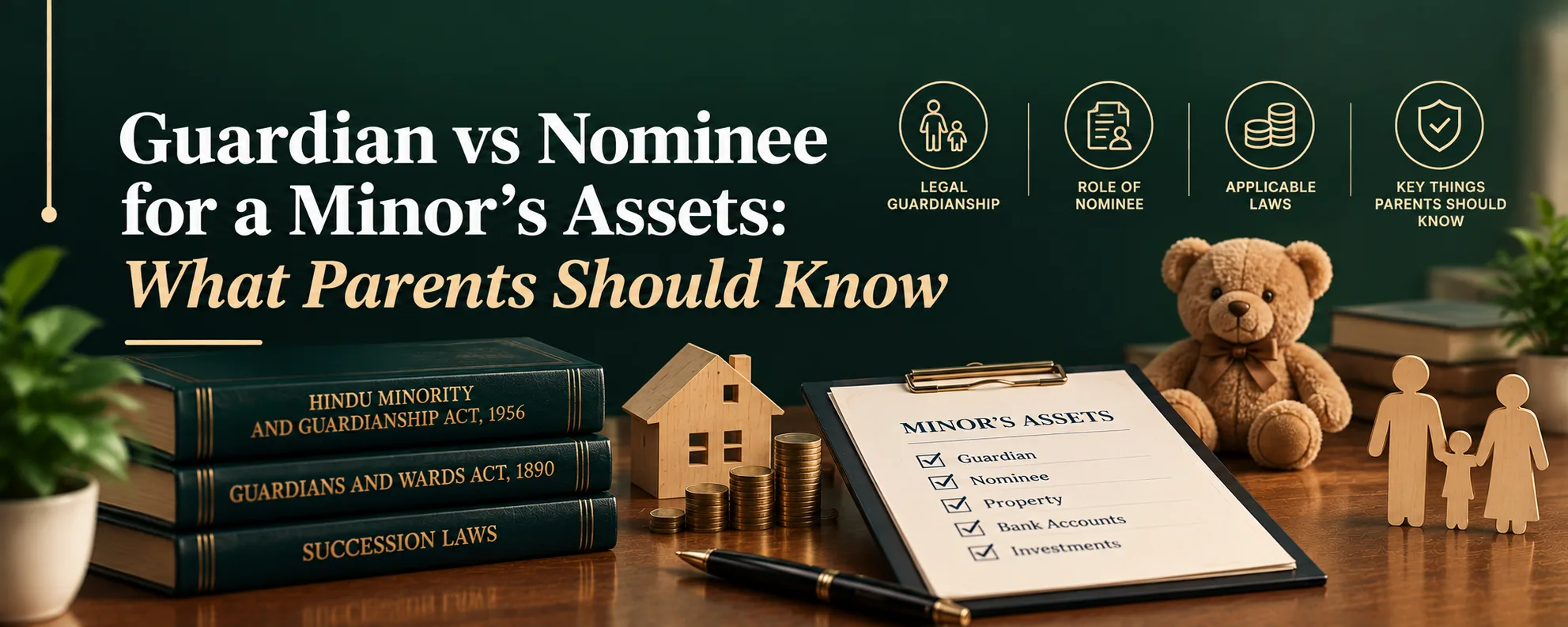
When planning for a child's financial future, parents must consider not only who will receive the money but also who will be legally responsible for managing it during the child's minority. These are distinct questions, and the answers depend on the asset and the applicable law.
A parent may nominate a child under a life insurance policy, invest in mutual funds in the child's name, or leave property to the child through a will. Each arrangement raises different legal questions. A nominee does not automatically become the child's guardian, just as a guardian does not become the owner of the child's assets.
Understanding the distinction between guardianship, nomination and succession can help parents plan more effectively and reduce the risk of future disputes.
What Does a Guardian Actually Do?
A guardian is legally responsible for a minor's person, property, or both, depending on the nature of the appointment. A guardian of the person deals with the child's care and welfare, while a guardian of property manages the minor's assets within the authority permitted by law. One person may perform both roles, but this is not automatic.
For Hindus, Buddhists, Jains and Sikhs covered by the Hindu Minority and Guardianship Act, 1956 (HMGA), Section 6 identifies natural guardians in specified circumstances. In Githa Hariharan v. Reserve Bank of India (1999), the Supreme Court clarified that “after him” in Section 6 does not necessarily mean after the father's death; it can mean in the father's absence. Section 8 regulates a natural guardian's powers over a Hindu minor's property.
For example, a natural guardian generally requires prior court permission to sell, mortgage, gift or otherwise transfer a Hindu minor's immovable property in the circumstances covered by Section 8. Transactions contrary to the statutory restrictions may be voidable at the instance of the minor or a person claiming under the minor.
The Guardians and Wards Act, 1890, provides an additional framework for court-appointed or court-declared guardians, subject to applicable personal law. Under Section 17, the court considers the child's welfare, the proposed guardian's capacity and relationship with the child, and other relevant circumstances, including a deceased parent's wishes where applicable.
The principle is clear: guardianship confers responsibilities and legally defined powers, not ownership of the child's property.
What Does a Nominee Do?
A nominee is designated under a particular financial arrangement to receive or claim an asset when a specified event occurs, commonly the account holder's or policyholder's death. The legal effect of nomination varies according to the governing statute and type of asset.
In some arrangements, a nominee is primarily authorised to receive the proceeds. In others, legislation expressly provides for beneficial entitlement. Nomination should therefore not be treated as a universal rule of ownership or inheritance.
Consider a parent who nominates a minor child under a life insurance policy. Section 39(1) of the Insurance Act, 1938, permits the policyholder to appoint a person, in the manner prescribed by the insurer, to receive the policy money if the policyholder dies while the nominee is still a minor.
This is a specific arrangement for receiving the proceeds. It does not automatically appoint that person as the child's guardian or authorise them to manage all the child's other assets.
Life Insurance: When Can a Nominee Be the Beneficial Owner?
Section 39 of the Insurance Act contains specific provisions on beneficial nomination.
Under Section 39(7), qualifying family nominees—including a policyholder's parents, spouse or children, or specified combinations of them—are generally beneficially entitled to the proceeds payable under Section 39(6), subject to the statutory conditions and the policyholder's title to the policy. Section 39(8) addresses certain cases in which a qualifying nominee dies after the insured person but before payment. These provisions were introduced by the Insurance Laws (Amendment) Act, 2015.
Accordingly, it would be incorrect to suggest that every life insurance nominee merely collects the money for the legal heirs. A qualifying child nominee may have beneficial entitlement under Section 39.
However, entitlement and the practical ability to receive and manage the proceeds are separate matters. Parents should consider the statutory arrangement for a minor nominee, the insurer's procedures and any separate guardianship requirements.
For example, a mother may nominate her eight-year-old daughter under a life insurance policy and appoint a suitable adult, in accordance with the insurer's procedure, to receive the proceeds during the daughter's minority. The adult's authority to receive the money does not, by itself, make that person its beneficial owner or the guardian of every other asset belonging to the daughter.
Can Parents Appoint a Guardian Through a Will?
A will can be an important part of planning for a minor child, but the effect of a testamentary appointment depends on the applicable law and family circumstances.
Section 9 of the HMGA regulates testamentary guardianship, including who may make the appointment and when it takes effect. A testamentary appointment does not automatically override the legal position of a surviving parent. Section 13 further provides that the minor's welfare is the paramount consideration in appointing or declaring a guardian.
Parents should distinguish between appointing a guardian and deciding who inherits their property. A will may address both matters where legally permissible, but the two functions are not interchangeable.
For instance, if a father leaves property to his minor son and appoints his sister as testamentary guardian, the sister does not become the property's owner. Her authority, when the appointment takes effect, remains subject to applicable law and the child's interests.
A will should therefore reflect the family's personal law, existing guardianship arrangements, ownership of the assets and intended estate distribution.
What About Mutual Funds and Other Investments?
Investments have their own legal and operational requirements. Parents should not assume that nomination under one financial product applies to another, or that being named a nominee automatically authorises someone to manage a minor's investments.
SEBI's mutual fund framework recognises investments held in a minor's name through a parent or lawful guardian. The guardian operates the investment in that capacity; the role does not make the guardian the beneficial owner of the minor's units.
SEBI's nomination rules for demat accounts and mutual fund folios have also changed. Its circular dated 29 May 2026, Circular No. SEBI/HO/OIAE/OIAE_IAD-3/P/CIR/2026/12676, modified the nomination framework with effect from 1 September 2026. Among other changes, the framework permits up to three nominees and makes nomination mandatory for qualifying newly opened single-holder accounts or folios unless the prescribed opt-out declaration is submitted; nomination remains optional for jointly held accounts or folios.
These rules concern nomination facilities and should not be confused with the separate requirements governing investments held by minors. Parents should verify the applicable procedures with the relevant mutual fund intermediary or depository participant.
The practical lesson is to keep nomination, investment management and guardianship arrangements distinct.
What Changes When the Child Turns Eighteen?
Section 3 of the Majority Act, 1875, generally provides that a person domiciled in India attains majority on completing eighteen years of age.
Once the child attains majority, authority based solely on the child's minority generally comes to an end, subject to any other applicable legal restriction or arrangement. The young adult can ordinarily manage their own affairs.
Parents should plan for this transition by maintaining proper asset records and helping the child understand what they own, how the assets have been managed and what steps may be required to take control of them.
Guardianship protects the child's interests during minority; it is not a means of securing permanent control over the child's property.
Practical Steps Parents Should Consider
A few precautions can help reduce uncertainty when arranging a child's financial future.
- Review each asset separately. Check the applicable nomination rules for insurance policies, bank accounts, mutual funds and securities.
- Plan guardianship and succession together. Consider a valid will and appropriate arrangements for managing the child's property.
- Choose the responsible adult carefully. Consider reliability, willingness and ability to act in the child's interests.
- Keep documents updated. Ensure nomination records, insurance documents, investment details and estate-planning documents reflect the intended arrangements.
- Maintain accountability. Understand the institution's process for releasing funds to or on behalf of a minor and keep records of how the child's assets are managed.
These steps cannot eliminate every dispute, but they can help distinguish the authority to receive money from the authority to manage it and from beneficial ownership.
Conclusion
A guardian and a nominee may both contribute to a child's financial security, but they perform different legal functions. A guardian is responsible for the minor's person, property, or both, within applicable legal limits. A nominee's rights depend on the particular financial arrangement and its governing law.
Parents should look beyond nomination forms and consider appropriate guardianship, succession and asset-management arrangements. Careful planning can reduce uncertainty and help protect the child's interests until they are legally able to manage their own affairs.
Disclaimer: This article is for general informational purposes only and does not constitute legal advice. The applicable law depends on the asset, personal law and individual circumstances. Consult a qualified legal professional before making consequential guardianship or estate-planning decisions.