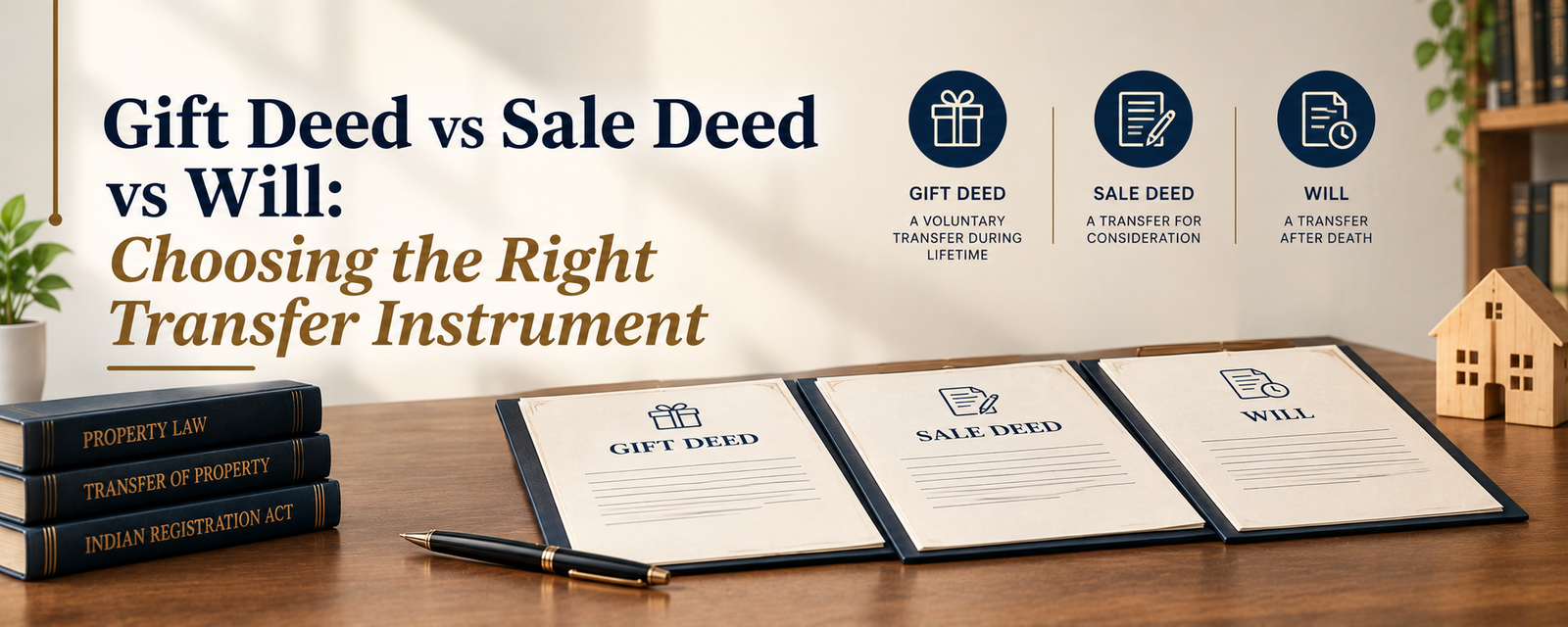
Transferring property involves more than signing a document. The instrument chosen determines when ownership passes, whether consideration is required, and how much control the owner retains. In India, a Gift Deed, Sale Deed and Will serve different legal purposes, even when they concern the same property or benefit the same family member.
A Gift Deed facilitates a voluntary transfer without consideration during the owner's lifetime. A Sale Deed records a transfer in exchange for a price. A Will expresses the owner's wishes regarding the distribution of property after death, ordinarily allowing the owner to retain control during their lifetime.
The appropriate choice depends on the intended outcome. Understanding the differences is essential because a document's title alone does not determine its legal effect. Its contents, execution, acceptance where required, and compliance with applicable law must also be considered.
Gift Deed: Transferring Property During Life
Section 122 of the Transfer of Property Act, 1882 defines a gift as the voluntary transfer of existing property without consideration by one person, the donor, to another, the donee, who accepts it. Acceptance must occur during the donor's lifetime and while the donor remains capable of giving. If the donee dies before acceptance, the gift is void.
Under Section 123 of the Transfer of Property Act, 1882, a gift of immovable property must be effected through a registered instrument signed by or on behalf of the donor and attested by at least two witnesses. Section 17(1)(a) of the Registration Act, 1908 independently requires registration of an instrument gifting immovable property. Merely handing over the keys or promising to gift a house does not ordinarily complete the legal transfer.
For example, a mother who wishes to transfer her flat immediately to her daughter without payment may execute a Gift Deed. Once the gift is validly completed, the daughter becomes the owner, subject to any rights lawfully reserved in the instrument.
A completed gift is not ordinarily revocable simply because the donor changes their mind. Section 126 of the Transfer of Property Act, 1882 permits revocation in specified circumstances, including an agreed condition based on an event that does not depend solely on the donor's will, or grounds on which a contract may be rescinded. A donor cannot generally reserve an unrestricted right to cancel an otherwise completed gift at will.
A Gift Deed is appropriate when the owner intends to transfer ownership during their lifetime and accepts the consequences of doing so. It is less suitable where the owner wishes to retain unrestricted ownership and the freedom to change the intended beneficiary.
Sale Deed: Transferring Property for a Price
Section 54 of the Transfer of Property Act, 1882 defines a sale as a transfer of ownership in exchange for a price paid, promised, or partly paid and partly promised. For ordinary sales of immovable property of the value specified in the section, ownership is transferred through a registered instrument. A contract for sale, by itself, does not create an interest in or charge on the property.
A Sale Deed is appropriate when a buyer acquires property for an agreed price. For instance, when someone purchases a residential flat from its owner, the deed records the property details, consideration and terms of transfer.
The substance of the transaction matters. A document labelled a Sale Deed does not turn a gratuitous transfer into a genuine sale merely because the parties use that description. Equally, a family relationship does not prevent a transaction from being a sale when a real price is payable.
Before purchasing property, the buyer should examine the seller's title, existing mortgages and other encumbrances, pending litigation, and restrictions affecting transfer. Registration creates an important formal record, but it does not independently establish that the seller had a valid title or cure defects in ownership.
A Sale Deed is generally the correct instrument for a genuine purchase transaction. Once the sale is legally completed, the seller cannot ordinarily undo it unilaterally merely because the seller regrets the decision.
Will: Providing for Succession After Death
A Will is a testamentary instrument expressing how a person's property should devolve after death. The person making it is the testator, and those intended to receive property are beneficiaries. Unlike a completed gift or sale, a Will ordinarily does not transfer ownership during the testator's lifetime.
For example, a father who wishes to leave his house to one child while retaining the ability to live in it, sell it or change his plans may execute a Will. Provided he has the legal capacity and authority to do so, he generally retains ownership and may alter or revoke the Will during his lifetime.
Section 63 of the Indian Succession Act, 1925 prescribes execution requirements for unprivileged Wills governed by that provision. Broadly, the testator must sign or mark the Will, or have another person sign it in the testator's presence and at the testator's direction. It must also be attested by at least two witnesses in the prescribed manner. Special rules and exceptions apply to certain Wills and testators.
Registration of a Will is generally optional under the Registration Act, 1908. Sections 18 and 27 address optional registration and the presentation of Wills for registration, respectively. Registration does not conclusively establish testamentary capacity, authenticity or freedom from undue influence.
The applicable personal law must also be considered. For example, Muslim testamentary dispositions are subject to distinct personal-law rules, including restrictions that may affect the extent to which property can be bequeathed. The legal position should therefore be assessed in the context of the testator's circumstances and applicable succession law.
A Will is usually appropriate where the owner wishes to retain control during life and provide for succession afterwards. Its effectiveness depends on valid execution, the testator's ownership rights and the succession law applicable to the person and property concerned.
Ownership, Possession and Life Interest
Ownership and possession are not the same. Ownership concerns legal title to property, while possession concerns its physical occupation or control. A person may own a house without living in it; conversely, someone may occupy a house without owning it.
An owner transferring property by Gift Deed may reserve a life interest—a legally defined right to use, occupy or receive income from the property during a specified person's lifetime. The precise rights depend on the instrument. Such a reservation does not necessarily prevent ownership from passing immediately to the recipient.
This distinction was examined by the Supreme Court in N.P. Saseendran v. N.P. Ponnamma & Ors., 2025 INSC 388, decided on 24 March 2025. The dispute concerned a 1985 settlement deed executed in favour of the owner's daughter, while the parents retained certain rights over the property. The Court examined the deed as a whole and concluded that it conveyed a present interest to the daughter. The reservation of life interest and postponement of physical possession did not convert the instrument into a Will. The Court also held that the completed disposition could not be cancelled unilaterally in the circumstances of the case.
The judgment reinforces an important principle: the nature of a property instrument depends on the rights it creates, not merely its label or the date on which possession is delivered. It does not establish that every settlement deed is a gift or that every reservation of life interest is valid regardless of wording and circumstances.
If an owner wishes to transfer title but continue residing in a house, the deed should expressly define the retained rights. If the owner instead wishes to retain ownership and the freedom to change the beneficiary, a Will may be more appropriate.
Choosing the Right Instrument
The central question is whether ownership should pass immediately or after death, and whether a price is being paid.
- A Gift Deed suits a voluntary transfer without consideration intended to take effect during the donor's lifetime.
- A Sale Deed suits a genuine transaction involving a price and a present transfer of ownership.
- A Will suits succession planning where the owner wants the intended transfer to take effect after death while retaining control during life.
Consider three situations. A parent who wants a child to become the present owner of a house may choose a Gift Deed, while reserving a properly drafted right of residence if necessary. A person selling a plot to a purchaser for an agreed price should ordinarily use a Sale Deed. An owner who wants to continue managing or selling a property during life, while naming a future beneficiary, would generally consider a Will.
Before deciding, consider the following questions:
- Should ownership pass now or after death? An immediate transfer points towards a Gift Deed or Sale Deed, while a disposition intended to operate after death points towards a Will.
- Is a genuine price being paid? If so, a Sale Deed is generally appropriate. A gift must be without consideration.
- Must the owner retain control? If continued ownership and freedom to revise the decision are priorities, a Will will usually be more suitable than an outright gift.
The answers should be considered alongside existing co-ownership, mortgages, third-party rights and restrictions on transfer. An owner can generally dispose only of the interest they legally possess. Special restrictions may apply to agricultural land, tribal land, leasehold property and property governed by particular statutory schemes.
Stamp Duty and Tax Considerations
Stamp duty and registration fees depend on the applicable State law, the nature and value of the property, the instrument and, in some jurisdictions, the relationship between the parties. Certain States provide concessions for gifts to specified relatives, but these should not be assumed to apply uniformly across India.
Income-tax consequences also differ. For tax years beginning on or after 1 April 2026, the Income-tax Act, 2025 applies, subject to its transitional provisions. Section 92(2)(m) addresses specified receipts of money and property without consideration or for inadequate consideration. Under Section 92(3), exceptions include qualifying receipts from defined relatives and property received under a Will or by inheritance. The definition of “relative” is specific and does not cover every family connection.
Section 70(1)(b) of the Income-tax Act, 2025 excludes qualifying transfers of capital assets by an individual or Hindu Undivided Family under a gift or Will from being treated as transfers for capital-gains purposes. However, when the recipient later sells the property, the rules governing cost of acquisition and holding period may affect the capital-gains calculation. A sale may create a tax liability for the seller, depending on the facts and applicable provisions.
Tax treatment should therefore be assessed separately from stamp duty and registration costs. Neither a Gift Deed nor a transfer between relatives should automatically be assumed to be tax-free or less expensive than a sale.
Conclusion
A Gift Deed, Sale Deed and Will are not interchangeable. The correct instrument depends on whether the owner intends to transfer property immediately without consideration, sell it for a price, or provide for its devolution after death. Particular care is needed where the owner wishes to retain the right to occupy or enjoy property after transferring ownership.
A carefully drafted instrument should reflect the actual arrangement, comply with statutory requirements and account for applicable personal laws, stamp duty, taxation and property restrictions. Registration is an important safeguard where required, but it is not a substitute for verifying title or ensuring that the transaction is legally valid.
Disclaimer: This article is intended for general legal information under Indian law and is not a substitute for advice on a specific transaction. The applicable requirements may vary with personal law, State legislation, property type and individual circumstances. Property owners should obtain appropriate legal and tax advice before executing or registering any transfer instrument.