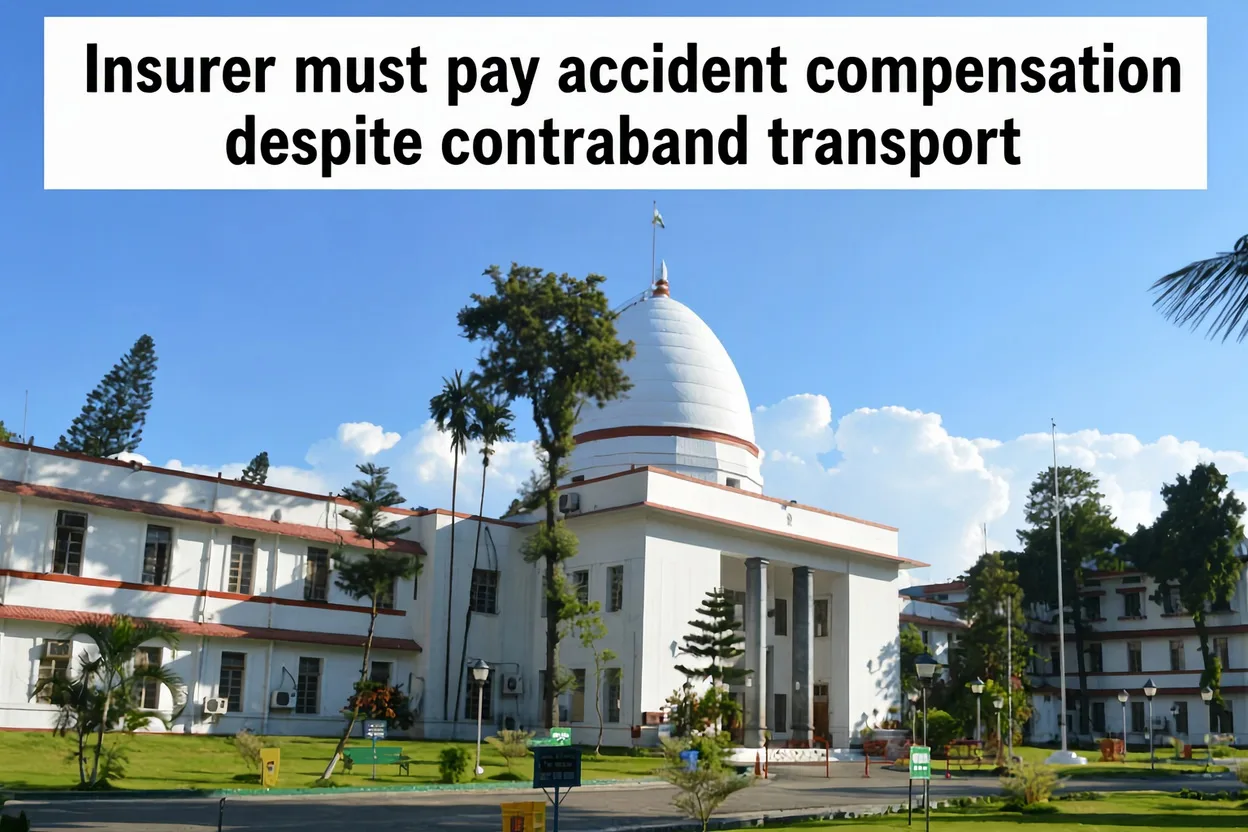
Gauhati High Court: Insurer Must Pay Third-Party Accident Compensation Despite Vehicle Carrying Contraband
The Gauhati High Court has held that an insurance company cannot escape its obligation to compensate third-party motor accident victims merely because the insured vehicle was allegedly carrying contraband goods in violation of the insurance policy. The Court directed the insurer to satisfy the compensation award first, while allowing it to recover the amount from the vehicle owner subsequently.
Justice Kardak Ete delivered the ruling in The Oriental Insurance Company Ltd. v. Shabanu Bibi & 7 Others, MACApp./353/2019.
Background of the Case
The case arose from a fatal road accident on June 9, 2011, when a truck collided with a Tata DI vehicle near Boraligaon while travelling towards Samaguri from Nagaon, Assam. The driver of the Tata vehicle, Rahul Ali, aged approximately 22 years, died at the spot.
His family subsequently filed a compensation claim under Section 166 of the Motor Vehicles Act, 1988, before the Motor Accident Claims Tribunal, Kamrup, Guwahati.
The Tribunal awarded compensation of ₹10.52 lakh, together with interest at 6% per annum from the date of filing the claim petition, and directed Oriental Insurance Company to satisfy the award.
Insurance Company's Arguments
Challenging the Tribunal's decision, Oriental Insurance Company argued that the offending truck was carrying ganja at the time of the accident, allegedly violating the terms and conditions of the insurance policy.
The insurer relied on police General Diary entries and witness testimony to establish the alleged breach. It also questioned the finding regarding negligence, arguing that the accident involved a head-on collision and that contributory negligence by the deceased had not been properly considered.
Court's Observations
The High Court noted that the materials on record indicated that the truck had been used for transporting contraband goods, suggesting a breach of the insurance policy conditions attributable to its owner.
However, the Court emphasised that third-party claimants should not suffer because of a dispute between the insurer and the insured, particularly when the vehicle's insurance coverage at the time of the accident was undisputed.
Relying on the Supreme Court's decision in Oriental Insurance Co. Ltd. v. Shri Nanjappan & Others, (2004) 13 SCC 224, and the subsequent ruling in Akula Narayana v. The Oriental Insurance Company Limited & Another (2025), the Court reiterated the principle of "pay and recover".
The Court held that the insurer must first satisfy the compensation award in favour of the third-party claimants and may subsequently recover the amount from the vehicle owner through appropriate execution proceedings, without instituting a separate recovery suit.
The High Court also rejected the insurer's argument regarding contributory negligence. It observed that merely establishing a head-on collision between two vehicles does not prove that the deceased contributed to the accident. There was no cogent evidence establishing negligent driving by the deceased.
Compensation Recalculated
The Court also reconsidered the compensation amount in light of the Supreme Court's decision in National Insurance Company Ltd. v. Pranay Sethi, (2017) 16 SCC 680.
Applying the principles governing future prospects, the Court added 40% to the deceased's assessed monthly income of ₹6,000. After deducting 50% towards personal expenses and applying a multiplier of 18, the loss of dependency was calculated at ₹9,07,200.
The Court additionally awarded ₹15,000 towards funeral expenses, ₹15,000 towards loss of estate and ₹40,000 towards loss of consortium.
Accordingly, the total compensation was recalculated from ₹10.52 lakh to ₹9,77,200, carrying interest at 6% per annum from the date of filing the claim petition until realisation.
Final Decision
The Gauhati High Court partly allowed the insurance company's appeal and modified the Tribunal's award. It directed Oriental Insurance Company to pay ₹9,77,200 with applicable interest to the deceased's family, while granting it liberty to recover the amount from the truck owner.
The ruling reinforces the protection available to third-party accident victims under motor vehicle insurance law and reiterates that a breach of policy conditions does not automatically defeat their right to receive compensation where the insurance coverage itself is undisputed.