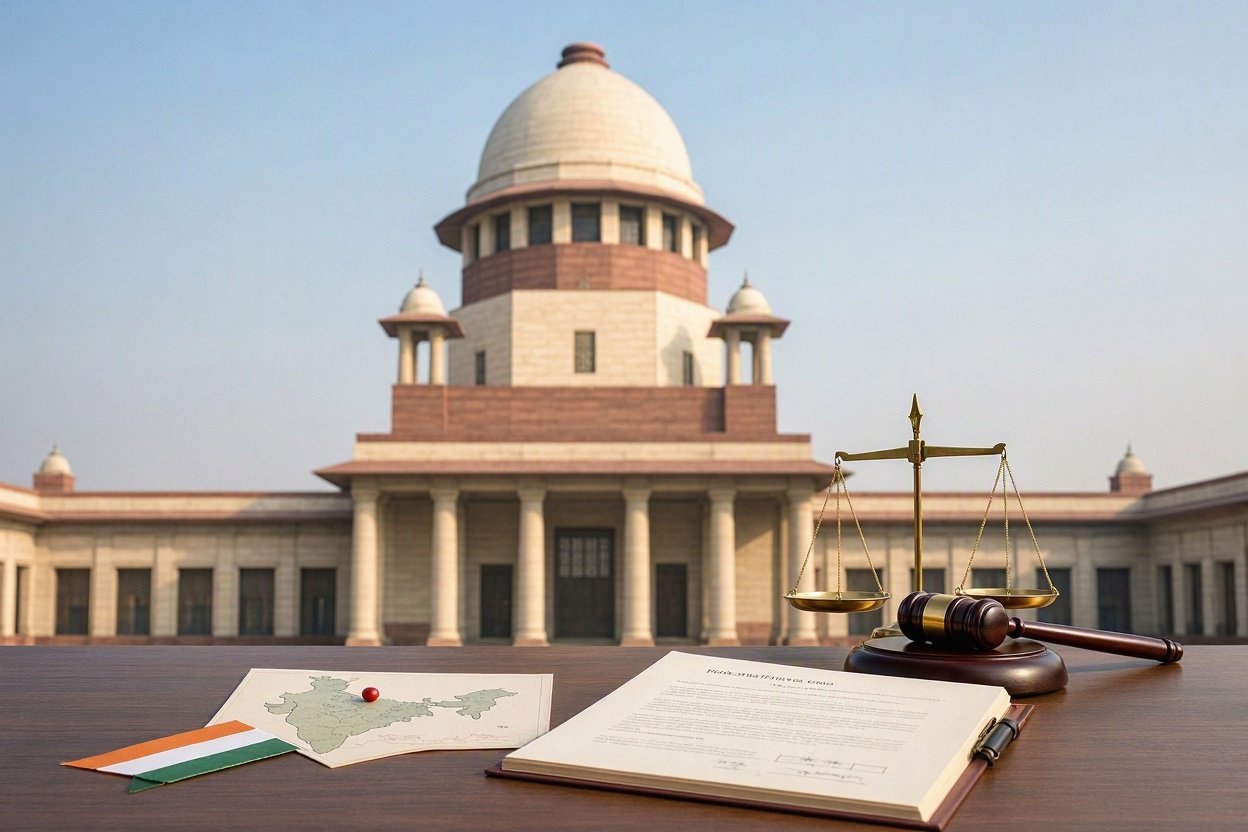
Doctrine of Seat of Arbitration in Indian Jurisprudence: Understanding Seat, Venue and Court Jurisdiction
Introduction
The distinction between the juridical seat and the physical venue of arbitration is a fundamental principle of Indian arbitration law. Although these terms may appear interchangeable, they serve different legal purposes. The seat determines the legal framework governing the arbitration and ordinarily identifies the courts exercising supervisory jurisdiction, whereas the venue generally refers to the physical location where hearings or other arbitral proceedings take place.
The Supreme Court of India has progressively clarified this distinction through several landmark judgments under the Arbitration and Conciliation Act, 1996. These decisions seek to uphold party autonomy, reduce jurisdictional conflicts and provide greater certainty in arbitration proceedings.
Statutory Framework under the Arbitration and Conciliation Act, 1996
Section 20 of the Arbitration and Conciliation Act, 1996, governs the place of arbitration. Under Section 20(1), the parties are free to agree on the place of arbitration. If they fail to reach an agreement, Section 20(2) empowers the arbitral tribunal to determine the place, having regard to the circumstances of the case and the convenience of the parties.
Section 20(3) separately permits the tribunal to meet at any appropriate location for consultations, hearing witnesses, experts or parties, and inspecting documents or property. Consequently, the location where a hearing occurs does not necessarily determine the juridical seat.
Section 2(1)(e), which defines the term “Court”, must also be read alongside Section 20 when determining which court has jurisdiction over arbitration-related applications.
Landmark Judicial Developments
1. Bharat Aluminium Co. v. Kaiser Aluminium Technical Services Inc. (BALCO)
The Constitution Bench decision in Bharat Aluminium Co. v. Kaiser Aluminium Technical Services Inc., (2012) 9 SCC 552, significantly shaped Indian arbitration jurisprudence. The Supreme Court adopted the territoriality principle, clarifying the applicability of Part I of the 1996 Act in relation to the seat of arbitration.
The judgment also contributed to the development of the principle that the courts associated with the juridical seat exercise supervisory authority over the arbitral process. It established an important foundation for subsequent decisions addressing the relationship between the seat and court jurisdiction.
2. Indus Mobile Distribution Pvt. Ltd. v. Datawind Innovations Pvt. Ltd.
In Indus Mobile Distribution Pvt. Ltd. v. Datawind Innovations Pvt. Ltd., (2017) 7 SCC 678, the Supreme Court clarified that the designation of a juridical seat operates similarly to an exclusive jurisdiction clause for arbitration-related proceedings.
Accordingly, once the parties designate a seat, the courts at that location ordinarily exercise exclusive supervisory jurisdiction over the arbitration, even where no part of the underlying cause of action arose there.
3. BGS SGS SOMA JV v. NHPC Ltd.
The decision in BGS SGS SOMA JV v. NHPC Ltd., (2020) 4 SCC 234, further clarified the distinction between the seat and venue. The Supreme Court examined the wording of arbitration clauses and explained how a designated venue may be treated as the juridical seat when the agreement, read as a whole, indicates that intention and no significant contrary indication exists.
The Court considered whether a reference to arbitration proceedings being held at a particular place indicates that the arbitration as a whole is anchored there, rather than merely permitting individual hearings at that location. The judgment also addressed the relationship between the seat and Section 42 of the 1996 Act.
4. Mankastu Impex Pvt. Ltd. v. Airvisual Ltd.
In Mankastu Impex Pvt. Ltd. v. Airvisual Ltd., (2020) 5 SCC 399, the Supreme Court emphasised that the determination of the seat cannot depend solely on the use of a particular word, such as “venue” or “place”. The arbitration clause must be interpreted in its entirety, taking into account the parties’ intention and the agreement's relevant provisions.
This approach reinforces the importance of contractual context when determining the juridical seat and the jurisdiction of Indian courts.
5. Inox Renewables Ltd. v. Jayesh Electricals Ltd.
In Inox Renewables Ltd. v. Jayesh Electricals Ltd., (2021) 5 SCC 671, the Supreme Court considered whether parties could mutually change the place of arbitration during the proceedings. The decision recognised the significance of party autonomy under Section 20(1), holding on the facts that the parties' mutual agreement could alter the seat without a formal amendment to the original contract.
The judgment demonstrates that the parties' subsequent mutual agreement may be relevant to determining the operative seat of arbitration.
6. BBR (India) Pvt. Ltd. v. S.P. Singhla Constructions Pvt. Ltd.
In BBR (India) Pvt. Ltd. v. S.P. Singhla Constructions Pvt. Ltd., (2023) 1 SCC 693, the Supreme Court considered whether a change in the location of hearings automatically changes the seat previously determined by the arbitral tribunal.
The Court clarified that the relocation of hearings does not, by itself, alter the juridical seat. A distinction must be maintained between the seat determined under Section 20(2) and the convenient locations permitted for proceedings under Section 20(3).
Recent Clarification: Mahanadi Coalfields
The LiveLaw analysis updated on 8 October 2026 discusses the Supreme Court's decision in Mahanadi Coalfields Ltd. v. GSCO Infrastructure Pvt. Ltd., identified in that analysis as 2026 INSC 1038 and dated 23 September 2026.
According to the report, the Court addressed whether the place where an arbitrator conducted hearings, and the location of the High Court involved in the appointment process, could determine the juridical seat in the absence of an express designation or an appropriate determination under the Act.
The reported ruling reinforces the principle that the mere convenience of conducting hearings at a particular place does not automatically establish that place as the juridical seat. It also highlights the importance of examining the contractual forum clause and the territorial connection of the courts approached.
The judgment should be consulted directly before relying on its precise holdings in litigation or legal advice.
Legal Principles Emerging from the Jurisprudence
- Party autonomy: The parties' agreement is the primary consideration in determining the seat under Section 20(1).
- Supervisory jurisdiction: Once a juridical seat is established, the courts at that seat ordinarily exercise exclusive supervisory jurisdiction over arbitration-related proceedings under Part I.
- Seat versus venue: The physical location of hearings does not automatically determine or change the juridical seat.
- Contextual interpretation: The arbitration clause must be read as a whole to identify the parties' intention.
- Tribunal-determined seat: Where the parties have not agreed on the place, the tribunal may determine it under Section 20(2).
- Mutual change: A subsequent agreement between the parties may alter the seat, subject to the applicable law and the facts of the case.
Conclusion
The doctrine of the seat of arbitration remains central to determining judicial supervision under Indian arbitration law. The decisions in BALCO, Indus Mobile, BGS SGS SOMA, Mankastu Impex, Inox Renewables and BBR (India) demonstrate the Supreme Court's continuing effort to distinguish the juridical seat from the physical venue.
For parties drafting arbitration clauses, clearly identifying the seat and separately addressing the location of hearings can help minimise jurisdictional disputes. For practitioners and businesses, the governing principle is that the seat must be determined through the parties' agreement, the applicable statutory framework and the relevant judicial precedents, rather than by relying solely on the place where hearings happen to occur.
Disclaimer: This article is intended for general legal information and educational purposes only. It is not legal advice. Readers should consult the relevant judgments and statutory provisions for the authoritative legal position.
```