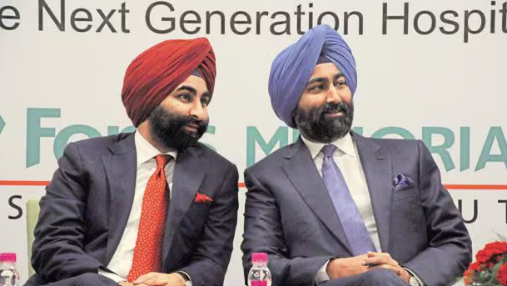
The Supreme Court of India has refused to interfere with a Delhi High Court order directing a forensic audit of transactions involving Fortis Healthcare and entities linked to its former promoters, Malvinder Mohan Singh and Shivinder Mohan Singh, in the ongoing enforcement proceedings initiated by Japanese pharmaceutical giant Daiichi Sankyo.
A Bench comprising Chief Justice of India Surya Kant, Justice Joymalya Bagchi, and Justice V. Mohana upheld the High Court's decision to conduct a forensic examination of transactions connected with the dilution of the Singh brothers' shareholding in Fortis Healthcare.
The dispute originates from a 2016 arbitral award obtained by Daiichi Sankyo against the Singh brothers following allegations of fraud and misrepresentation arising from the sale of Ranbaxy Laboratories. Since securing the award, Daiichi has been pursuing enforcement proceedings to recover the awarded amount.
During the proceedings, concerns were raised regarding the significant reduction of the Singh brothers' stake in Fortis Healthcare and related transactions involving entities such as IHH Healthcare and RHT Health Trust. The Delhi High Court had ordered a comprehensive forensic audit to reconstruct the movement of shares, funds, and associated transactions.
Fortis Healthcare challenged the High Court's order before the Supreme Court, arguing that it was neither a party to the arbitration proceedings nor a judgment debtor. The company further contended that, as a listed entity, it lacked the legal authority to restrict transfers of dematerialized shares by its shareholders.
However, the Supreme Court declined to halt the audit. At the same time, the Court clarified that observations made by the Delhi High Court against Fortis were merely tentative and prima facie in nature and should not influence the forensic auditor's findings.
The apex court emphasized that the audit must be conducted independently and objectively. The ruling allows the forensic investigation to proceed while safeguarding the neutrality of the process and preserving Fortis Healthcare's right to challenge any adverse findings that may arise later.
The decision represents another significant development in one of India's longest-running corporate enforcement disputes involving arbitration awards, promoter shareholding, and corporate governance issues.