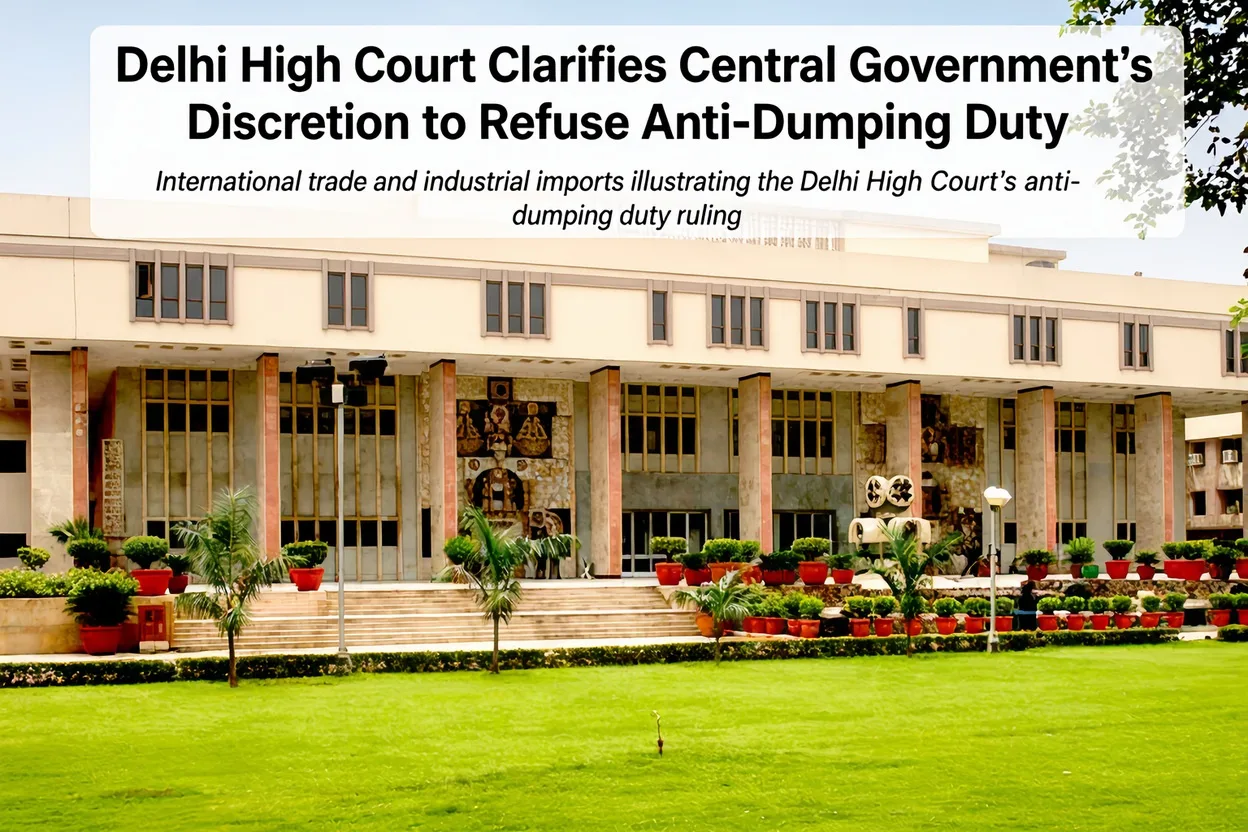
Delhi High Court: Centre Can Refuse Anti-Dumping Duty Despite Designated Authority's Recommendation
The Delhi High Court has held that the Central Government is not obligated to impose anti-dumping duty merely because the Designated Authority has recommended it following an investigation. The Government retains statutory discretion to consider broader public interest, including the interests of consumers and industries dependent on imported goods.
The ruling was delivered on 17 November 2026 by a Division Bench comprising Justice Anil Kshetarpal and Justice Harish Vaidyanathan Shankar in Supreme Petrochem Ltd. v. Union of India & Anr., W.P.(C) 10289/2020.
Background of the Dispute
Supreme Petrochem Limited, a domestic manufacturer of polystyrene, approached the Designated Authority along with other Indian producers seeking anti-dumping duty on imports originating in or exported from Iran, Malaysia, Singapore, Chinese Taipei, the United Arab Emirates and the United States.
After conducting an investigation, the Designated Authority issued affirmative final findings on 12 June 2020, recommending the imposition of definitive anti-dumping duty on the specified imports.
However, the Central Government, through an Office Memorandum dated 11 November 2020, decided not to impose the recommended duty. Challenging this decision, Supreme Petrochem approached the Delhi High Court, questioning both the Government's decision and the constitutional validity of the relevant statutory provisions.
Petitioner's Arguments
The petitioner argued that the Central Government could not disregard the Designated Authority's affirmative findings without adequate justification. It contended that the recommendation followed a detailed investigation into dumping, injury to the domestic industry and the causal relationship between them.
The company also challenged the discretion granted to the Government under Section 9A(1) of the Customs Tariff Act, 1975, arguing that it was excessive, unguided and inconsistent with Article 14 of the Constitution.
Government's Power Under Section 9A
Rejecting the challenge, the Court emphasised the language of Section 9A(1) of the Customs Tariff Act, 1975, which states that the Central Government may impose anti-dumping duty through a notification in the Official Gazette.
The Bench explained that the Designated Authority primarily investigates whether dumping has occurred, whether the domestic industry has suffered injury and whether a causal connection exists. Its findings and recommendations do not automatically compel the Central Government to impose duty.
The final decision rests with the Central Government, which is entitled to consider wider economic and public-interest factors beyond the protection of domestic manufacturers.
Public Interest Must Be Balanced
The Court observed that anti-dumping measures must not become instruments of excessive protectionism. The Government is required to balance the interests of domestic manufacturers against those of downstream industries and the consuming public.
In the present dispute, one of the three domestic manufacturers of polystyrene had ceased operations following a fire. This raised concerns regarding the ability of the remaining two manufacturers to meet domestic demand if imports became more expensive due to additional anti-dumping duties.
The Government had also obtained assessments from NITI Aayog and other agencies regarding the possible effects of imposing duty on domestic supply and industries dependent on polystyrene.
The Court accepted that these considerations were relevant to the broader public-interest assessment and were distinct from the Designated Authority's technical examination of injury to domestic manufacturers.
Consistency With WTO Anti-Dumping Agreement
The Bench also examined Article 9.1 of the WTO Anti-Dumping Agreement. The provision recognises that importing countries retain the authority to decide whether anti-dumping duty should be imposed even when the necessary conditions for its imposition have been fulfilled.
The Court held that India's two-stage mechanism, involving investigation by the Designated Authority followed by the Central Government's final decision, was consistent with this international framework.
Government's Discretion Is Not Beyond Judicial Review
While recognising the Government's discretion, the Court clarified that such power is not unlimited or immune from judicial scrutiny.
Decisions refusing to impose anti-dumping duty remain subject to judicial review where they involve irrelevant considerations, mala fides, arbitrariness or a lack of rational connection with the material considered.
The Court further held that the Government's ultimate decision was legislative or quasi-legislative in character and did not require a separate oral hearing after the Designated Authority had completed its investigation.
Delhi High Court Dismisses the Petition
Finding that the Central Government's decision was supported by relevant material and legitimate public-interest considerations, the Division Bench declined to interfere with the decision.
The Court rejected the constitutional challenge to Section 9A(1) of the Customs Tariff Act, 1975, read with Rule 18 of the Anti-Dumping Rules, 1995, and dismissed Supreme Petrochem's petition.
Significance of the Judgment
The ruling clarifies the distinction between the investigative role of the Designated Authority and the final decision-making authority of the Central Government in anti-dumping matters.
It establishes that a positive recommendation does not create an automatic right to anti-dumping protection. The Government may decline to impose duty after considering the wider economic consequences for downstream industries, consumers and domestic supply.
For importers, manufacturers and businesses dependent on imported raw materials, the decision highlights the importance of public-interest considerations in India's trade-remedy framework.