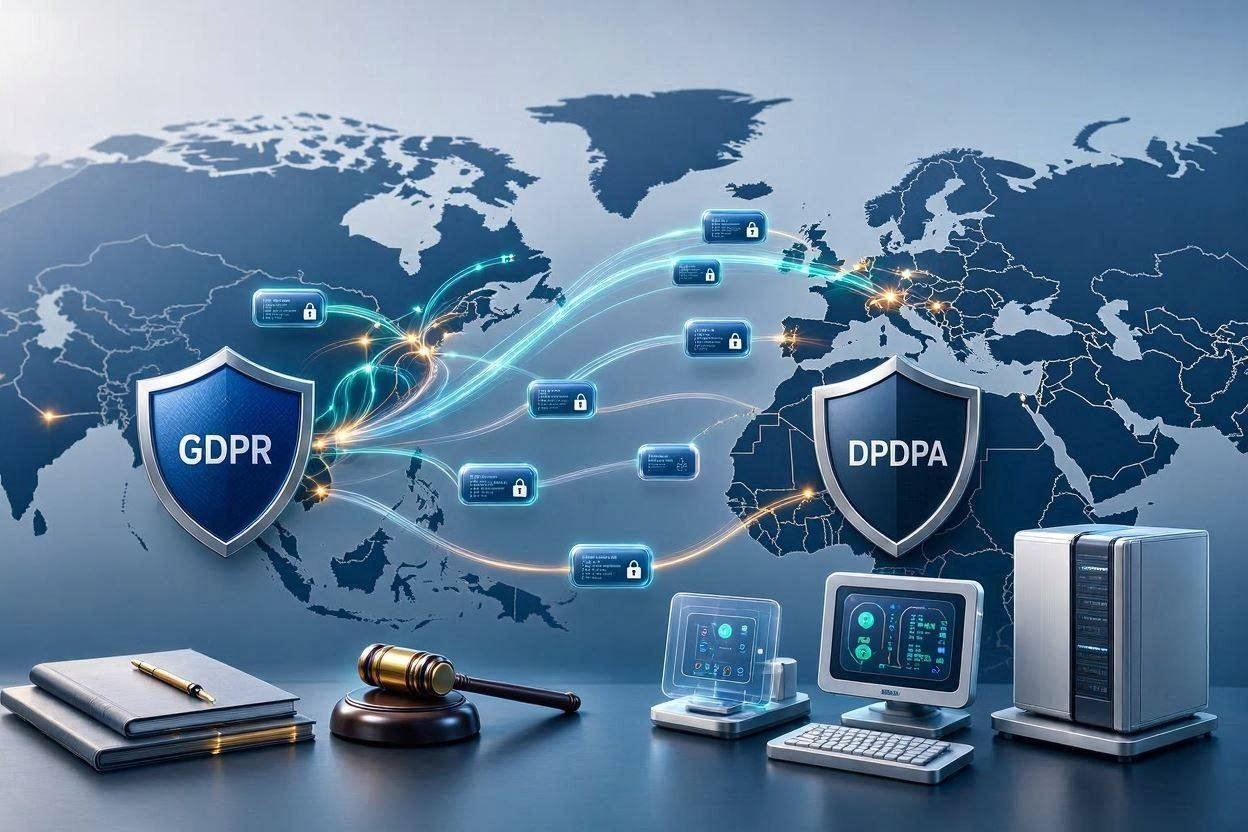
Cross-Border Transfer of Healthcare Data: Reconciling India's DPDPA with GDPR
The rapid digital transformation of healthcare has fundamentally changed the way medical services are delivered worldwide. Telemedicine, cloud-based health records, AI-assisted diagnostics, and cross-border consultations have made healthcare more accessible than ever. However, the international flow of sensitive patient information raises complex legal and regulatory questions regarding privacy, security, and compliance.
At the center of this discussion are two major data protection frameworks: the European Union's General Data Protection Regulation (GDPR) and India's Digital Personal Data Protection Act, 2023 (DPDPA). While both seek to protect personal information, their treatment of healthcare data and cross-border transfers differs significantly.
Healthcare Data Under GDPR and DPDPA
GDPR classifies health information as a “special category” of personal data requiring enhanced safeguards and stricter processing conditions. Healthcare records, medical histories, diagnostic reports, and biometric data receive a higher level of legal protection due to their sensitive nature.
In contrast, India's DPDPA does not create a separate category for healthcare data. Instead, all identifiable information is treated as personal data under a uniform framework. As a result, highly sensitive medical records receive the same statutory classification as less sensitive personal information.
Cross-Border Data Transfers: Two Different Models
The GDPR follows a “whitelist” or adequacy-based approach. Personal data can be transferred outside the European Economic Area only when the recipient country provides an adequate level of protection or when specific safeguards such as Standard Contractual Clauses (SCCs) or Binding Corporate Rules (BCRs) are implemented.
India's DPDPA adopts a more permissive “negative-list” approach. Under Section 16 of the Act, cross-border transfers are generally allowed unless the Central Government specifically restricts or prohibits transfers to designated jurisdictions.
Implications for Healthcare Organizations
The divergence between the two frameworks creates compliance challenges for hospitals, telemedicine platforms, health-tech startups, insurers, and multinational healthcare providers. Organizations operating across jurisdictions must often comply simultaneously with GDPR's stringent requirements and DPDPA's evolving framework.
Healthcare providers increasingly rely on cloud services, artificial intelligence, and international specialist consultations. These activities frequently involve the transfer of patient information across national borders, making regulatory compliance a critical operational requirement.
Key Risks
- Exposure of sensitive medical records in jurisdictions with weaker privacy protections.
- Regulatory uncertainty for health-tech companies handling multinational patient data.
- Cybersecurity threats targeting healthcare databases.
- Potential conflicts between local healthcare regulations and international privacy obligations.
The Road Ahead
As India's digital health ecosystem expands, policymakers may face increasing pressure to introduce more nuanced protections for healthcare data. The challenge will be balancing innovation, international data flows, and patient privacy while ensuring interoperability with global standards such as GDPR.
For healthcare providers and technology companies, robust governance frameworks, contractual safeguards, cybersecurity measures, and transparent consent mechanisms will remain essential for maintaining trust and regulatory compliance in an increasingly interconnected healthcare environment.