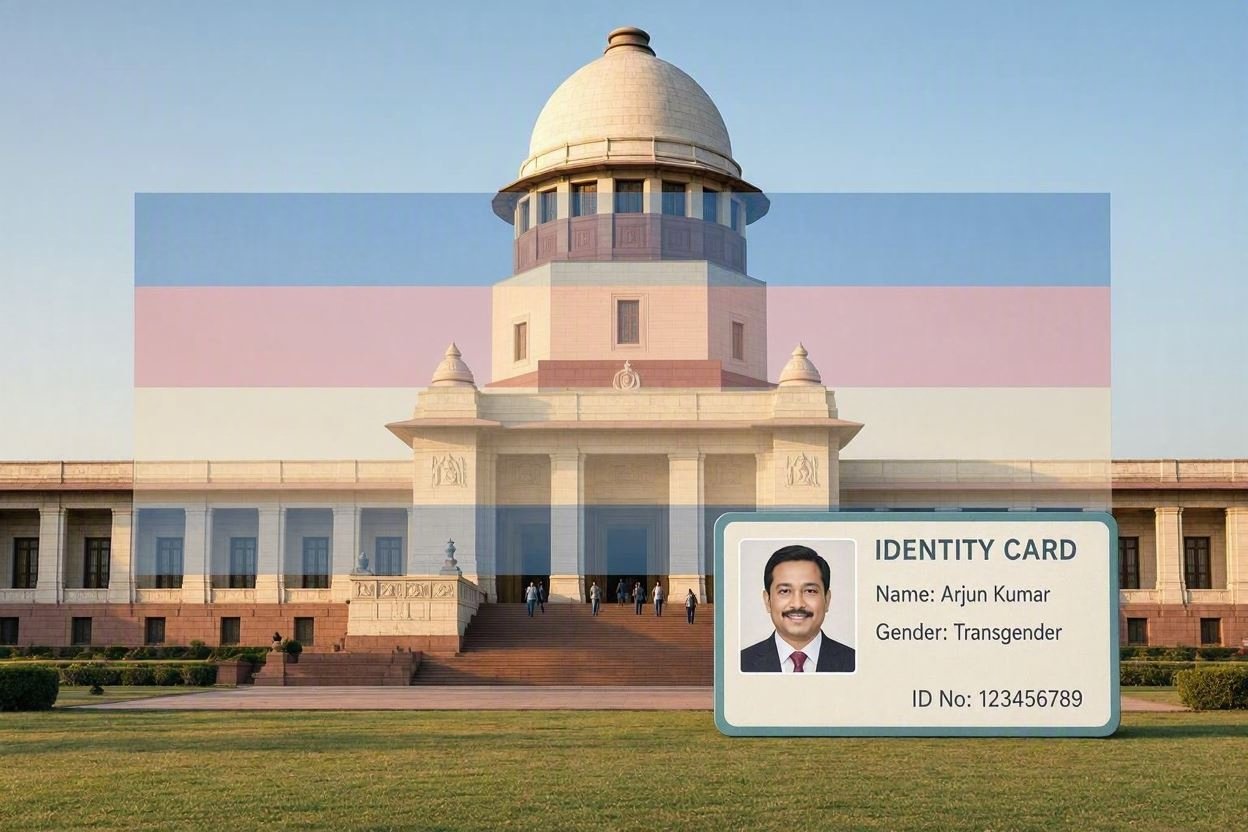
The Union Government has assured the Supreme Court that transgender identity cards issued prior to the enactment of the Transgender Persons (Protection of Rights) Amendment Act, 2026, will continue to remain valid until the constitutional challenges against the legislation are finally adjudicated.
The assurance was recorded during the hearing of a batch of petitions challenging the constitutional validity of the 2026 amendment. The petitioners have argued that the amended framework dilutes protections previously available to transgender persons and alters the legal process governing recognition of gender identity.
Appearing for the Union Government, Solicitor General Tushar Mehta informed the Court that identity cards already issued under the previous legal regime would continue to operate and would not be rendered ineffective merely because the amended law has come into force.
The Supreme Court was examining concerns raised by petitioners regarding transgender individuals whose identity cards had allegedly been cancelled, replaced, or whose applications remained pending after the amendment became operational. The Court sought clarity on whether rights already accrued under the earlier framework would continue to be protected.
The Centre's statement provides interim relief to transgender persons who obtained recognition and documentation under the pre-amendment regime. The government also indicated that it would file its detailed response to the petitions challenging the amendment.
The Court is expected to continue hearing the matter after receiving the Union's reply. The outcome of the proceedings could have significant implications for the recognition of gender identity, access to welfare benefits, and the broader framework governing transgender rights in India.
The litigation forms part of a wider debate surrounding the Transgender Persons (Protection of Rights) Amendment Act, 2026, which has been challenged on grounds that certain provisions may be inconsistent with constitutional guarantees of equality, dignity, privacy, and the principles recognized by the Supreme Court in earlier transgender rights jurisprudence.