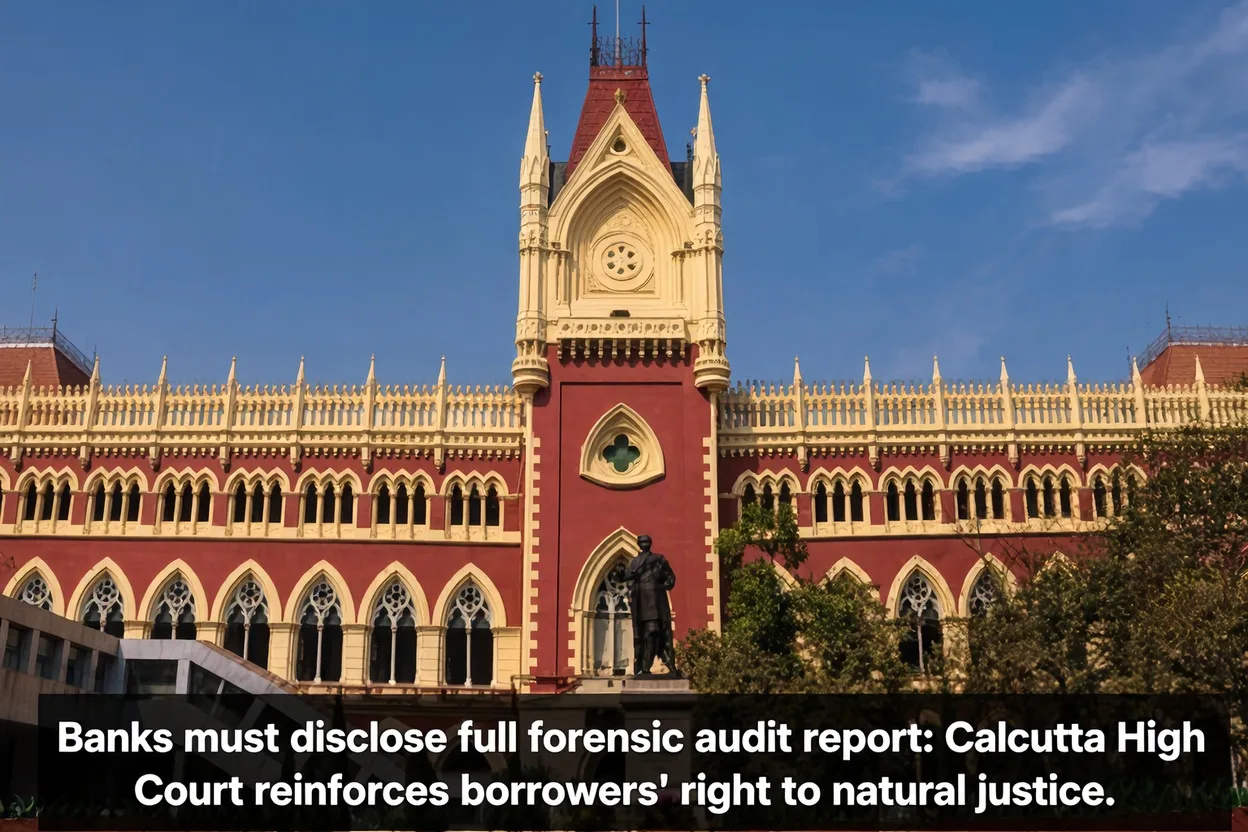
The Calcutta High Court has held that banks must furnish borrowers with the complete Forensic Audit Report (FAR) relied upon before classifying their loan accounts as fraudulent. The Court emphasised that withholding the forensic audit report without legally sustainable reasons violates the principles of natural justice.
Background of the Case
In Ridhi Sidhi Cold Storage Pvt. Ltd. & Ors. v. Punjab National Bank & Anr., the petitioners, comprising a borrower company and its directors, challenged the decision of Punjab National Bank to classify their loan account as a fraud account.
The bank had issued a show-cause notice proposing fraud classification and subsequently communicated its decision to classify the account as fraudulent. The petitioners requested copies of the documents relied upon by the bank, particularly the complete forensic audit report, to enable them to respond effectively to the allegations.
However, the bank supplied only extracts of the forensic audit report, withholding portions that allegedly contained information concerning bank officials and third parties. The petitioners argued that such incomplete disclosure deprived them of a meaningful opportunity to defend themselves.
Key Legal Issue
The central question before the Court was whether a bank could classify a borrower's account as fraudulent while withholding the complete forensic audit report forming the basis of its decision.
What Did the Court Hold?
Justice Partha Sarathi Chatterjee held that the bank was required to furnish the entire forensic audit report, subject only to permissible redactions justified by the rights or privacy of third parties.
The Court relied upon the Supreme Court's decision in State Bank of India v. Amit Iron Private Limited & Ors. (2026 INSC 323), which clarified that disclosure of audit reports, including forensic audit reports, is mandatory where they are relied upon for fraud classification.
The Court further observed that merely providing extracts or conclusions from an audit report does not satisfy the requirements of natural justice because the underlying reasons and supporting material are contained within the report itself.
It clarified that banks may withhold specific portions affecting third-party rights or privacy, but must identify those portions and record appropriate reasons. The power of redaction cannot be exercised arbitrarily.
Important Clarification on Personal Hearing
The Court also clarified that borrowers are not entitled, as a matter of right, to a personal or oral hearing before their accounts are classified as fraudulent. A reasonable opportunity to submit a written representation after receiving the forensic audit report is sufficient, provided the representation is independently considered and a reasoned decision is passed.
Final Directions
The Calcutta High Court set aside the communication classifying the petitioners' account as fraudulent and revived the original show-cause notice.
The bank was directed to furnish the forensic audit report, subject to legally permissible and reasoned redactions. The petitioners must thereafter receive a reasonable opportunity to submit their representation, following which the competent authority must pass a fresh, reasoned and speaking order in accordance with the applicable RBI Directions.
The Court expressly stated that it was not deciding whether the petitioners had actually committed fraud. The bank was also permitted to continue its pending proceedings before the Debts Recovery Tribunal.
Why Does This Judgment Matter?
The ruling strengthens procedural safeguards available to borrowers facing fraud classification by banks. Such classification can have serious civil and financial consequences, making access to the evidence relied upon essential for an effective defence.
It reinforces that financial institutions must balance regulatory compliance with procedural fairness and cannot bypass natural justice by withholding material documents from borrowers.
Case Details
- Case: Ridhi Sidhi Cold Storage Pvt. Ltd. & Ors. v. Punjab National Bank & Anr.
- Case Number: WPO 342 of 2024
- Court: Calcutta High Court
- Judge: Justice Partha Sarathi Chatterjee
- Judgment Date: 20 November 2026
- Relevant Law: RBI Master Directions on Fraud Risk Management, 2024; principles of natural justice.