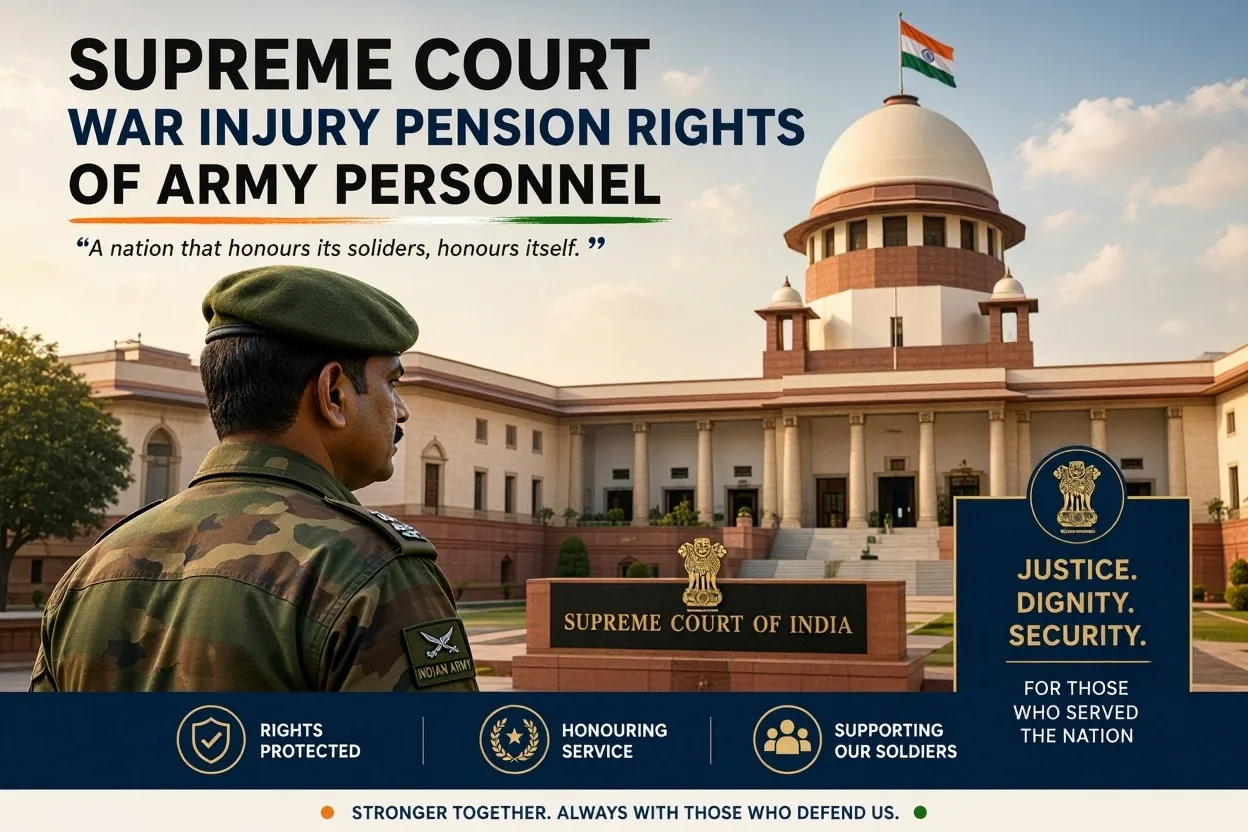
Supreme Court Holds Accidental Gunshot Injury from Own Service Weapon Eligible for War Injury Pension
The Supreme Court of India has held that an accidental gunshot injury sustained by an Army personnel from his own service weapon during operational duty can qualify as a Battle Casualty, making the individual eligible for the enhanced War Injury Element of pension.
The ruling was delivered in JC-377745M Ex Sub Maj & Hony Lt Devi Singh v. Union of India & Ors. (2026 INSC 1256), by a Bench comprising Justice Satish Chandra Sharma and Justice Nongmeikapam Kotiswar Singh on November 20, 2026.
Background of the Case
The appellant, Devi Singh, a retired Army Subedar Major and Honorary Lieutenant, sustained a gunshot injury on August 7, 2002, while performing operational duty in Jammu and Kashmir during Operation Rakshak. His loaded service weapon accidentally discharged, and the bullet passed through his left thigh, damaging his femoral vein.
The Release Medical Board assessed his disability at 40% for life and considered the injury attributable to military service. However, the Army granted him only the ordinary Disability Element of pension instead of the enhanced War Injury Element.
His claim was subsequently rejected by the Armed Forces Tribunal, principally because final Battle Casualty approval from the competent military authority was unavailable and his name did not appear in the relevant digital database. The original Army records had also been destroyed in the 2014 floods while in official custody.
Supreme Court's Observations
Setting aside the Tribunal's decision, the Supreme Court clarified that an injury cannot automatically be classified as self-inflicted merely because the weapon belonged to the injured serviceman.
The Court distinguished accidental discharge from deliberate self-inflicted injuries, observing that a service weapon may discharge accidentally due to an impact, fall, snagging of the trigger, inadvertent pressure or mechanical defect.
It emphasised that weapon ownership and intention are separate considerations. The source of the bullet, by itself, cannot establish that the injury was deliberately self-inflicted.
The Bench relied on contemporaneous Army records, including Part II Order No. BC-59 dated December 16, 2002, which recorded the incident under the heading "Battle Casualty Wound OP Rakshak OP Parakram", along with the surviving Battle Casualty Certificate and medical records.
The Court found that the requirements under Paragraph 69 of Army Order 1/2003/MP were satisfied: the injury had the necessary operational connection and was grievous in nature. It also recognised that the absence of the appellant's name from a subsequently created digital database could not disprove surviving contemporaneous and signed official records.
Relevant Legal Provisions
- Regulation 82, Pension Regulations for the Army, Part I, 2008: Governs the relevant categories of war injuries.
- Regulation 103, Pension Regulations for the Army, Part I, 2008: Provides for payment of the War Injury Element upon subsequent retirement or discharge in qualifying cases.
- Paragraph 69, Army Order 1/2003/MP: Prescribes the relevant conditions for classification as a Battle Casualty.
Final Decision
The Supreme Court allowed the appeal and set aside the Armed Forces Tribunal's orders dated May 10, 2023, and July 19, 2023.
It directed the Union Government to sanction and pay the War Injury Element of pension to Devi Singh with effect from his date of retirement, subject to adjustment of the Disability Element already paid for the same disability and period.
The authorities were further directed to issue the revised Pension Payment Order and pay the net arrears within three months from the date of the judgment.
Significance of the Judgment
The decision reinforces the principle that accidental injuries sustained during qualifying military operations cannot be denied enhanced pensionary benefits merely because the serviceman's own weapon caused the injury. It also underscores the evidentiary importance of contemporaneous official records and protects retired personnel from being prejudiced by the subsequent loss of government records.