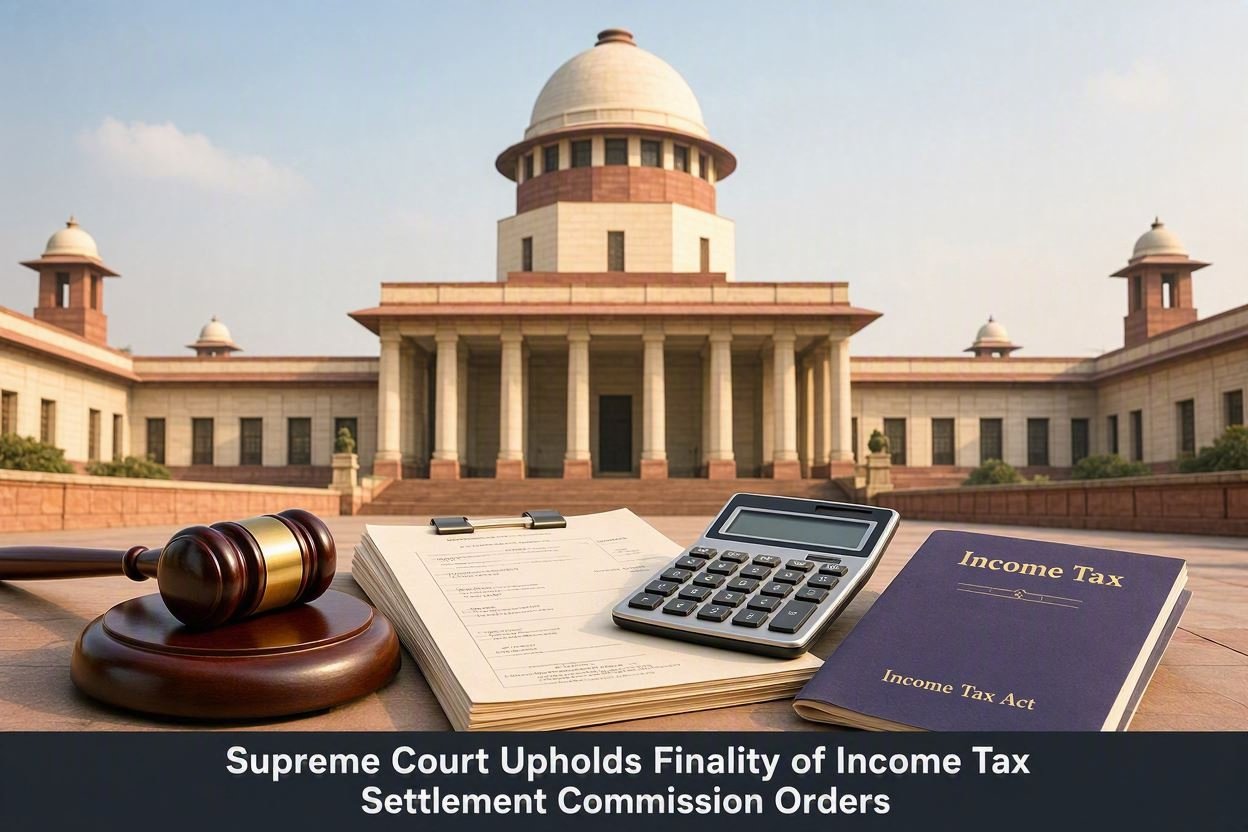
New Delhi, September 16, 2026: The Supreme Court has ruled that an Assessing Officer (AO) cannot initiate reassessment proceedings under Section 148 of the Income Tax Act once the Income Tax Settlement Commission (ITSC) has passed a final settlement order determining the assessee's taxable income.
A Bench comprising Justice S.V.N. Bhatti and Justice N.V. Anjaria delivered the judgment in Assistant Commissioner of Income Tax & Anr. v. M/s. Omaxe Limited, dismissing the Revenue's appeal and affirming the Delhi High Court's decision that had quashed reassessment proceedings against the real estate company.
The dispute originated after Omaxe Limited approached the Income Tax Settlement Commission following a search and seizure operation. The settlement application covered Assessment Years 2000-01 to 2006-07. In March 2008, the Commission passed a final order under Section 245D(4), determining the company's taxable income and allowing deductions claimed under Section 80-IB(10).
Subsequently, based on a survey conducted in 2009, the Revenue issued a notice under Section 148 seeking to reassess the company's tax liability by disallowing deductions worth approximately ₹55.58 crore relating to four housing projects.
The Supreme Court held that such reassessment was legally impermissible because the issues had already attained finality through the Settlement Commission's order. The Court observed that Parliament intended settlement proceedings to provide certainty and finality, and allowing reassessment by the AO would undermine that legislative objective.
The Bench clarified that where the Revenue believes a settlement order was obtained through fraud or misrepresentation, the Income Tax Act already provides a remedy under Section 245D(6). In the present case, the Revenue had invoked that provision, but the Settlement Commission rejected the allegation of misrepresentation.
Emphasising the statutory scheme, the Court noted that the Revenue actively participates in settlement proceedings and is afforded an opportunity to present its objections before the Commission. Therefore, once a settlement order becomes final, regular reassessment mechanisms cannot be used to revisit the same issues.
The judgment reinforces the finality of settlement proceedings and provides greater certainty to taxpayers who have resolved disputes through the statutory settlement mechanism.
Case: Assistant Commissioner of Income Tax & Anr. v. M/s. Omaxe Limited
Citation: 2026 LiveLaw (SC) 944