Building a business with a co-founder often begins with a shared vision, mutual trust, and the belief that both founders are working towards the same goal. One person may have the idea, another may bring technical knowledge, while someone else may contribute capital, business connections, or management skills.
In the early stages, these contributions are often discussed informally. Founders may agree on who will do what, how much ownership each person will receive, and how profits will eventually be shared. Since everyone is working towards the same objective, putting these understandings into a formal document may appear unnecessary.
But what happens when the business grows and the interests of the founders begin to change?
A founder who was initially working full-time may leave. Another may contribute significantly more money than expected. Disagreements may arise over ownership, decision-making, intellectual property, salaries, or the future direction of the company.
This is where a Founders' Agreement becomes important.
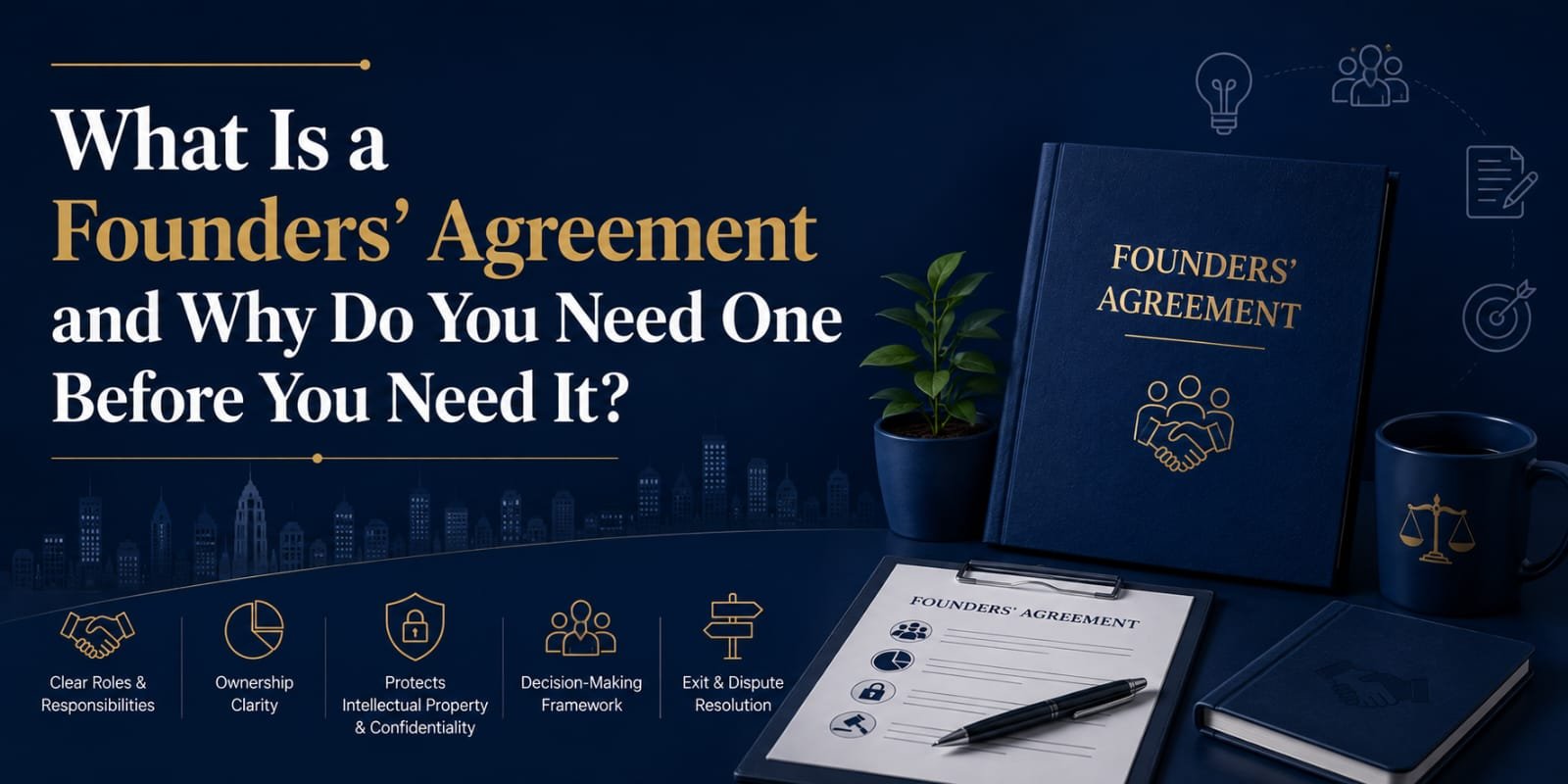
A Founders' Agreement is essentially a contract between the founders of a business that records their understanding regarding ownership, responsibilities, decision-making, intellectual property, confidentiality, exit arrangements, dispute resolution, and other matters concerning their relationship with one another and the business.
It is not a separate statutory document that every company is required to execute under the Companies Act, 2013. Its legal effect generally arises from contract law, subject to the nature of the arrangement and other applicable laws. Section 10 of the Indian Contract Act, 1872 sets out the requirements for agreements to become contracts, including free consent, competency of parties, lawful consideration, and lawful object.
The real value of such an agreement is not that it predicts every problem. Rather, it creates a common understanding before disagreements arise.
The phrase "before you need one" is important. A Founders' Agreement is most useful when the relationship between founders is still functioning well. Once a serious dispute has developed, agreeing on the basic rules can become much more difficult.
What Is a Founders' Agreement?
A Founders' Agreement is a written agreement entered into by the founders of a business to define their respective rights, obligations, contributions, and relationship with each other.
There is no single mandatory format. Its contents depend upon the nature of the business, the number of founders, the stage of the business, and the expectations of the parties.
The agreement may define each founder's role, record proposed ownership, identify expected contributions, and establish how important decisions will be made.
This becomes particularly important when the business is incorporated as a company. The Companies Act, 2013 governs matters such as incorporation, share capital, transfer of securities, management, and other corporate matters. In the case of a private company, restrictions on the transfer of shares also form part of the statutory framework applicable to its Articles of Association.
Therefore, a Founders' Agreement should not be viewed in isolation. Once a company has been incorporated, arrangements concerning share transfers and corporate governance should be considered alongside its Articles of Association and applicable law. A private agreement between founders cannot override a mandatory statutory requirement.
What Does a Founders' Agreement Usually Cover?
The contents may differ from business to business, but several matters are commonly important.
Ownership, Contributions and Vesting
One of the first questions founders should settle is: who owns what?
A founder may contribute money, while another may contribute technical knowledge, intellectual property, industry experience, or full-time work. The agreement can record the proposed shareholding of each founder and the contributions expected from them.
A 50:50 arrangement may seem fair at the beginning, but circumstances can change. One founder may work full-time while another becomes less involved, or one may contribute additional funds when the business needs financing.
These questions are easier to address before the business becomes valuable.
Founders may also consider vesting arrangements, particularly where a founder receives a substantial equity interest but is expected to remain involved for a specified period. Vesting can determine how that equity is treated if the founder leaves before the agreed period is completed.
Vesting is not a general statutory rule applicable to every founder. The mechanism should be structured consistently with the company's legal and securities framework.
Roles and Decision-Making
The Founders' Agreement can identify the role of each founder and the responsibilities attached to it. It can also establish whether founders are expected to work full-time, whether outside employment is permitted, and how significant changes in responsibilities will be decided.
Decision-making is equally important.
Where founders have equal voting power, disagreements over raising capital, selling the company, or changing its direction can create a deadlock.
The agreement can establish which decisions require ordinary approval and which require the consent of all or specified founders. It can also provide a process for dealing with deadlocks, such as negotiation, mediation, appointment of an independent adviser, or another agreed procedure.
The objective is not to prevent disagreement, but to ensure that disagreement does not automatically bring the business to a standstill.
Intellectual Property and Confidentiality
For many startups, intellectual property can be one of their most valuable assets.
Founders may contribute software, designs, inventions, trademarks, written content, databases, or other intellectual property. If ownership is not clearly addressed, disputes may later arise over whether that intellectual property belongs to the individual founder or the business.
The agreement should identify important intellectual property and clarify what is being contributed to the business and what, if anything, must be assigned or otherwise transferred to the company.
This is particularly important where intellectual property was created before incorporation. A founder becoming a shareholder does not, by itself, necessarily mean that all intellectual property personally owned by that founder automatically becomes the company's property.
The applicable intellectual property law must also be followed. For example, Section 19 of the Copyright Act, 1957 contains specific requirements concerning copyright assignments. Similarly, Section 68 of the Patents Act, 1970 contains requirements concerning assignments and certain other dealings with patents.
Therefore, simply stating that "all intellectual property belongs to the company" may not be sufficient in every situation. Where an assignment is required, the relevant statutory requirements and appropriate documentation should be followed.
Confidentiality should also be addressed. Founders may have access to business plans, customer information, pricing, financial information, source code, and other sensitive material. A confidentiality clause can establish obligations regarding the use and disclosure of such information, including what happens when a founder leaves.
Founder Exit and Transfer of Shares
One of the necessary questions for founders is: what happens if one of us leaves?
A founder may leave voluntarily, stop contributing, become unable to continue, or breach important obligations. The agreement may provide mechanisms dealing with these situations, including notice periods, valuation, buy-out arrangements, and treatment of equity.
Founders should also consider what happens if one founder wants to transfer their shares to an outsider.
Depending on the business structure and applicable law, the agreement may contain provisions concerning rights of first refusal, tag-along rights, drag-along rights, and other transfer or exit arrangements.
Such provisions should be considered alongside the Companies Act, 2013 and the Articles of Association. Contractual arrangements should not conflict with mandatory corporate requirements.
Restrictive Covenants
Founders may want to address whether a departing founder can immediately start or join a competing business.
This requires particular caution under Indian law.
Section 27 of the Indian Contract Act, 1872 deals with agreements in restraint of trade. Therefore, a broad post-exit non-compete clause should not simply be inserted because it appears in a standard template.
A commercially sensible restriction is not necessarily legally enforceable in every situation. Confidentiality obligations, protection of trade secrets, and other legitimate business interests may need to be addressed through carefully drafted provisions that comply with applicable law.
Compensation and Dispute Resolution
Founders do not always receive salaries during the early stages of a business. Some may work without immediate compensation, while others may receive salaries or reimbursement for business expenses.
These arrangements should ideally be recorded rather than left to assumptions. The agreement may specify compensation, expense reimbursement, and how changes to founder compensation will be approved.
Even with a carefully drafted agreement, disputes can still occur. The Founders' Agreement can establish how those disputes should be handled before they escalate.
The founders may agree to attempt negotiation or mediation first and, where appropriate, proceed to arbitration or court proceedings in accordance with the agreed terms and applicable law. The agreement should also clearly identify the applicable law and, where relevant, the arbitration mechanism or jurisdiction.
Why Should Founders Sign One at the Beginning?
The most common reason founders delay preparing an agreement is simple: "We trust each other."
Trust is valuable, but a contract is not necessarily evidence of distrust.
A Founders' Agreement allows difficult questions to be discussed while there is still goodwill between the founders. It is easier to decide what should happen if a founder leaves when everyone is working well together than when one founder has already announced their resignation.
Similarly, discussing ownership before the company becomes valuable is generally easier than renegotiating ownership after one founder believes they have contributed more than another.
The agreement therefore acts as a framework for the future and creates a written record of what the founders actually agreed upon, rather than leaving important matters to memory, informal messages, or oral conversations.
Common Mistakes Founders Should Avoid
Founders should consider more than just their initial ownership split. Some recurring issues deserve attention before the business becomes more difficult to restructure.
- Relying only on verbal understandings for ownership, responsibilities, contributions, or founder exits can create uncertainty later.
- Treating ownership as the only important issue can leave roles, decision-making, intellectual property, confidentiality, funding obligations, and exits unresolved.
- Using a generic online template without understanding its provisions may result in terms that do not reflect the founders' actual arrangement.
- Ignoring future scenarios, such as a founder leaving, additional funding being required, disagreement over a sale, or disputes concerning intellectual property, can make later negotiations more complicated.
A template may provide a useful starting point, but every business has different founders, contributions, funding arrangements, and risks.
When Should You Have a Founders' Agreement?
Ideally, founders should discuss and document their important arrangements once they have decided to seriously pursue the business together and before significant money, intellectual property, or business value has accumulated.
This does not mean every detail must be finalised when the first business idea is discussed. However, once founders are committing time, money, or intellectual property to the venture, important expectations should not remain entirely informal.
Waiting until the company has raised investment, hired employees, acquired customers, or become profitable can make negotiations more complicated. By then, founders may have developed different expectations about ownership and control.
The earlier these questions are discussed, the easier it generally is to establish a common understanding.
Conclusion
A Founders' Agreement is not about planning for failure. It is about planning responsibly for the possibility that circumstances may change.
The relationship between founders may begin with friendship, trust, and a shared vision. But businesses evolve. Contributions change, responsibilities expand, financial pressures arise, and individual circumstances can change.
A clear Founders' Agreement gives founders a framework for dealing with those changes. It can address ownership, responsibilities, decision-making, intellectual property, confidentiality, compensation, founder exits, and dispute resolution.
At the same time, it is not a substitute for the Companies Act, 2013, the Articles of Association, or other documents that may be required or appropriate for the particular business. Its provisions should be drafted according to the actual structure of the venture and reviewed alongside other corporate and contractual arrangements.
The objective is not to predict every possible problem. No agreement can do that. The objective is to ensure that when an important question arises, the founders are not starting the conversation from zero.
The founders may trust each other today. The purpose of a Founders' Agreement is not to question that trust. It is to make sure that if circumstances change tomorrow, everyone knows what they had agreed upon.
The best time to decide what happens when things go wrong is while everything is still going right.
Disclaimer: This article is intended for general informational purposes only and does not constitute legal advice. The enforceability of specific provisions depends on the facts, drafting, corporate structure, and applicable law. Founders should obtain appropriate legal advice before entering into or relying upon a Founders' Agreement.