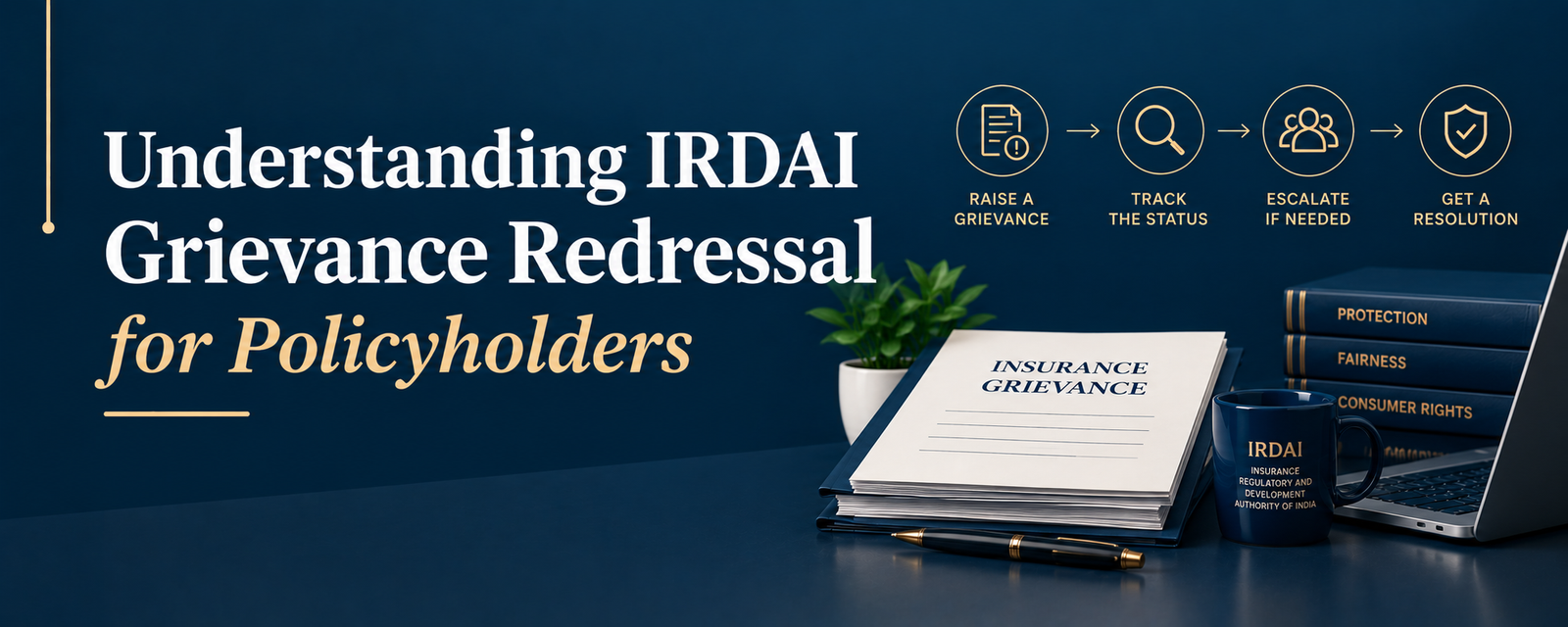
An insurance policy is meant to provide financial protection when an unexpected event occurs. However, the process does not always go as smoothly as policyholders expect. A claim may be delayed, rejected, partially settled, or disputed because of the interpretation of policy terms. In such situations, knowing where and how to raise a grievance becomes important.
In India, policyholders are not limited to repeatedly contacting their insurance company or accepting a decision they believe is incorrect. The Insurance Regulatory and Development Authority of India (IRDAI) has established a grievance redressal mechanism through which complaints can be raised and monitored. The Insurance Ombudsman also provides a separate forum for resolving eligible disputes.
But what should a policyholder do when an insurer does not respond, or when the response does not address the complaint? Understanding the available channels, their roles and their limitations can help policyholders take informed steps towards resolving an insurance dispute.
Legal Framework for Policyholder Grievances
The grievance redressal framework in India operates through the Insurance Regulatory and Development Authority of India Act, 1999, the applicable IRDAI regulations, including the IRDAI (Protection of Policyholders’ Interests, Operations and Allied Matters of Insurers) Regulations, 2024, and the Insurance Ombudsman Rules, 2017, as amended.
The 2024 Regulations form part of the regulatory framework governing insurers’ obligations towards policyholders. These requirements operate alongside the Insurance Ombudsman Rules, 2017, which provide a mechanism for resolving certain disputes between policyholders and insurers.
The two mechanisms serve different purposes. The insurer’s internal grievance redressal system is the first point of contact. IRDAI facilitates the examination and resolution of complaints by insurers and monitors the grievance redressal process. The Insurance Ombudsman, on the other hand, provides a separate dispute resolution mechanism for complaints falling within its jurisdiction.
This distinction matters because approaching IRDAI does not automatically result in an order directing an insurer to pay a disputed claim. Similarly, the Ombudsman can consider only complaints that satisfy the applicable eligibility and procedural requirements.
Step 1: Filing a Complaint with the Insurer
The first step for a policyholder is to approach the insurance company directly. Insurers are required to have a grievance redressal mechanism, generally through a Grievance Redressal Officer (GRO), to receive and address complaints.
A complaint should be made in writing, either through the insurer’s designated online facility, email or other prescribed channel. It should clearly explain the issue and identify the relief sought. For example, a policyholder disputing a rejected health insurance claim should explain why the rejection is being challenged and refer to the relevant policy terms, where possible.
Supporting documents are equally important. Depending on the nature of the grievance, these may include the policy document, claim form, hospital bills, discharge summary, correspondence with the insurer, claim rejection letter and other relevant records. Keeping copies of the complaint and all communications can help establish what was submitted and when.
Under IRDAI’s grievance redressal framework, insurers are expected to resolve grievances within 15 days of receiving them. A policyholder should therefore keep track of the date on which the complaint was submitted and the response received.
If the insurer rejects the complaint, provides a response that does not resolve the issue, or fails to respond within the prescribed period, the policyholder may consider escalating the grievance. The next step depends on the nature of the dispute and the remedy being sought.
Step 2: Escalation Through Bima Bharosa
When an insurer does not resolve a grievance satisfactorily, the policyholder can approach IRDAI through its Bima Bharosa platform. Bima Bharosa is IRDAI’s integrated grievance-management system that allows policyholders to register complaints and track their status.
A complaint can be registered online through the Bima Bharosa website. Policyholders are generally required to provide details of the insurer, policy, grievance and the steps already taken to resolve the matter. Relevant documents should also be uploaded wherever required.
Once registered, the complaint is forwarded to the concerned insurer through Bima Bharosa. The system also enables IRDAI to monitor the complaint and the insurer’s response. A unique complaint or token number is generated, which can be used to track the grievance.
Bima Bharosa is not a court or a separate claims tribunal. Its purpose is to facilitate the grievance redressal process and enable IRDAI to monitor how insurers handle complaints. Where necessary, IRDAI may take up the matter with the insurer and facilitate its re-examination and resolution.
The Bima Bharosa website also indicates that a complaint should be attended to within 15 days of registration. This is distinct from the insurer’s general obligation to resolve a grievance within 15 days of receipt. A complaint being marked as attended to does not necessarily mean that the policyholder has received the outcome sought.
If the policyholder remains dissatisfied with the insurer’s response, the matter may be taken further through the appropriate channel. For disputes that fall within its jurisdiction, this may include approaching the Insurance Ombudsman.
Role of the Insurance Ombudsman
The Insurance Ombudsman provides an alternative mechanism for resolving eligible insurance disputes without requiring policyholders to immediately approach a court. It is intended to offer a cost-effective and impartial process for dealing with grievances against insurers.
The Insurance Ombudsman Rules, 2017 set out the complaints that may be considered and the procedure for filing them. The mechanism covers complaints relating to personal lines of insurance, group insurance policies, and policies issued to sole proprietorships and micro enterprises, subject to the Rules.
A policyholder may approach the Ombudsman after first raising the complaint with the insurer. The complaint may be taken forward where the insurer has rejected it, the policyholder is dissatisfied with the response, or the insurer has not responded within one month. The complaint must also fall within the Ombudsman’s jurisdiction.
The Rules cover several types of grievances, including delays in claim settlement, partial or total repudiation of claims, disputes relating to premiums, misrepresentation of policy terms, and certain policy servicing issues. Complaints may also concern policies issued contrary to the proposal form or non-issuance of a policy after receipt of premium, where the relevant requirements are met.
There is also a monetary limit. Under the Rules, as amended in 2023, the Ombudsman may award compensation up to ₹50 lakh, including expenses claimed. The policyholder must also approach the Ombudsman having territorial jurisdiction in accordance with the Rules.
The process begins with an attempt to resolve the dispute through mediation. If both parties agree to a settlement recommendation and the complainant accepts it as a full and final settlement, the insurer is required to comply within 15 days of receiving the recommendation.
If the dispute remains unresolved through mediation, the Ombudsman may proceed to pass an award. The award is required to be passed within three months of receiving all the requirements from the complainant. It is binding on the insurer, which must comply within 30 days of receiving it and inform the Ombudsman of its compliance.
The Ombudsman mechanism is therefore distinct from the IRDAI grievance platform. While Bima Bharosa facilitates and monitors the insurer’s handling of a complaint, the Ombudsman can resolve eligible disputes through a recommendation or an award under the Rules.
Practical Challenges and Limitations
Although the grievance redressal framework provides multiple avenues for policyholders, using these mechanisms may still involve practical difficulties.
One common challenge is understanding the reason for a claim rejection. Insurance policies contain detailed terms, exclusions and conditions. A policyholder may find it difficult to determine whether a rejection is justified or whether the insurer has applied a policy condition correctly. This is particularly relevant in health and life insurance claims, where the decision may depend on medical records, disclosures or the precise wording of the policy.
Documentation can also affect the process. Missing records, incomplete complaint details or unclear communication may delay the examination of a grievance. Policyholders should therefore preserve the policy document, claim-related records, bills, rejection letters and all correspondence with the insurer.
Another limitation is that grievance redressal does not guarantee the outcome sought by the policyholder. IRDAI facilitates the examination of complaints by insurers, but it does not automatically direct payment of every disputed claim. Similarly, the Ombudsman can consider only matters that fall within the jurisdiction and monetary limits prescribed by the Rules.
There may also be situations where a policyholder needs to consider other legal remedies. The availability of the grievance redressal mechanism does not mean that every dispute must end there. Depending on the facts and applicable law, a policyholder may have recourse to an appropriate Consumer Commission or court. The choice of remedy should take into account the nature of the dispute, the applicable procedure and any relevant limitation period.
For policyholders, the practical lesson is to act promptly, maintain a clear record of communications and understand the scope of each available forum before escalating a complaint.
Conclusion
Insurance grievance redressal is not limited to raising a complaint with the insurer and waiting for a response. The framework provides a sequence of mechanisms through which policyholders can seek resolution, beginning with the insurer’s grievance redressal system, followed where necessary by IRDAI’s Bima Bharosa platform and, for eligible disputes, the Insurance Ombudsman.
Each mechanism has a different role, and none guarantees that a disputed claim will be decided in the policyholder’s favour. However, understanding the procedure, keeping relevant documents and observing the applicable timelines can help policyholders present their grievances more effectively.
Ultimately, an accessible grievance redressal system is meaningful only when policyholders know how to use it. Awareness of these remedies is therefore an important part of understanding the rights and responsibilities that come with an insurance policy.
Disclaimer: This article is intended for general informational purposes only and does not constitute legal advice. The applicable procedure may vary depending on the facts of an individual case and the law in force.