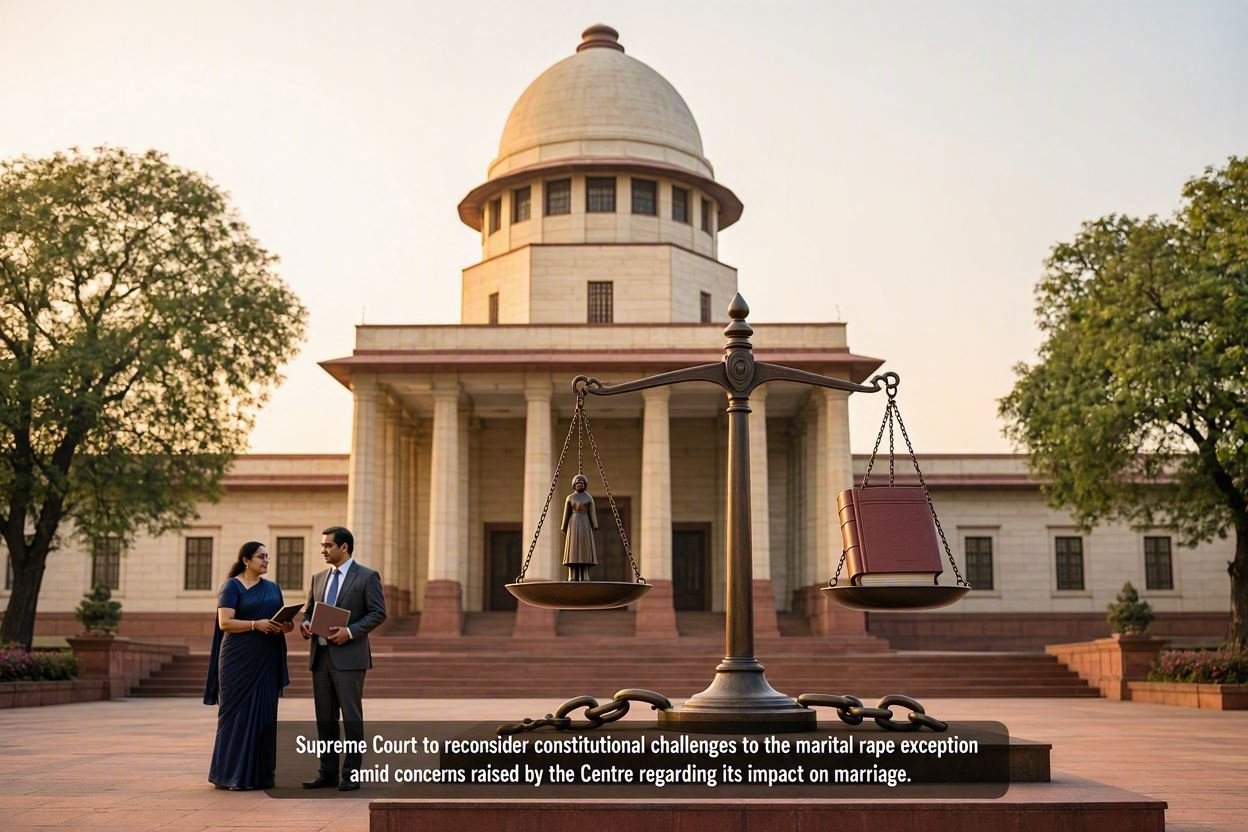
The Supreme Court of India is poised to revisit one of the most significant constitutional challenges in contemporary criminal jurisprudence—the validity of the marital rape exception under Indian law. The matter came before a Bench led by Chief Justice of India Surya Kant, which indicated that it would first consider the Union Government’s response before scheduling a substantive hearing.
The petitions challenge the statutory exception that excludes certain non-consensual sexual acts committed by a husband against his adult wife from the offence of rape. The issue has remained contentious for years, raising questions relating to bodily autonomy, equality, dignity, privacy, and the legal status of consent within marriage.
During proceedings on September 7, 2026, senior counsel appearing for various parties sought a fixed schedule for hearing. The Court observed that it would examine the Union Government’s stand before deciding the future course of the matter.
The challenge traces its roots to multiple proceedings, including the Karnataka High Court decision in Hrishikesh Sahoo v. State of Karnataka and the Delhi High Court’s split verdict on the constitutional validity of the marital rape exception. While Justice Rajiv Shakdher held the exception unconstitutional for violating fundamental rights, Justice C. Hari Shankar upheld its validity, leading to appeals before the Supreme Court.
The Union Government has consistently opposed striking down the exception through judicial intervention. In earlier affidavits, the Centre argued that while a married woman's consent remains important, treating violations within marriage identically to rape outside marriage could have broader social and legal implications. The Government has maintained that the issue requires a holistic legislative approach and warned that criminalisation may impact the institution of marriage.
The controversy has continued under the Bharatiya Nyaya Sanhita, 2023, which retained a substantially similar marital rape exception. Petitioners contend that retaining the exception discriminates against married women by denying them legal protection available to unmarried women. They argue that marriage cannot be treated as irrevocable consent to sexual intercourse.
The Supreme Court's eventual decision is expected to have far-reaching consequences for criminal law, constitutional rights, gender justice, and matrimonial jurisprudence in India. The upcoming hearings are therefore likely to be closely watched by legal practitioners, policymakers, civil society organisations, and women's rights advocates.