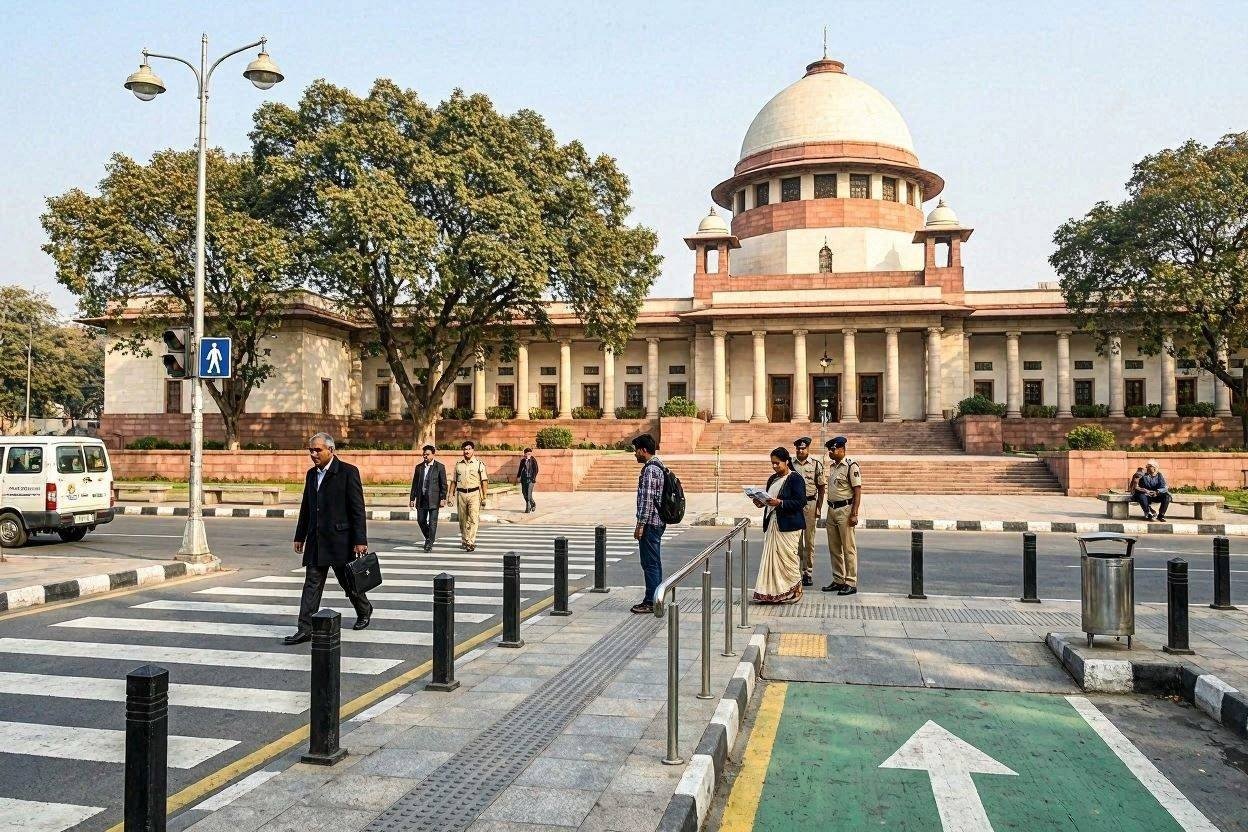
In a landmark judgment reinforcing pedestrian rights and urban accessibility, the Supreme Court of India has declared that the right to walk safely on demarcated footpaths is a fundamental right protected under the Constitution.
A Bench comprising Justice P.S. Narasimha and Justice Atul S. Chandurkar held that the right to walk forms an integral part of the freedom of movement guaranteed under Article 19(1)(d), read with Article 21, which protects the right to life and personal liberty.
The Court emphasized that citizens are entitled to safe, accessible, and properly demarcated footpaths and that this right must receive priority over the movement of motorised vehicles. Observing that pedestrians are among the most vulnerable road users, the Court stated that urban infrastructure must be designed to protect and facilitate pedestrian mobility.
The judgment arose in the context of concerns regarding inadequate pedestrian infrastructure, unsafe road conditions, and the absence of properly maintained footpaths across cities and towns. The Court noted that a road without safe pedestrian access undermines constitutional guarantees and exposes citizens to avoidable risks.
Recognising the constitutional dimensions of pedestrian safety, the Court held that public authorities have a corresponding duty to create, maintain, and protect footpaths. Municipal bodies, urban development authorities, and other governmental agencies cannot ignore this obligation.
The Court further observed that violations of the right to walk on safe footpaths may entitle affected individuals to seek constitutional remedies, including restitution and compensation, independent of remedies available under other statutory frameworks.
In addition, the Supreme Court urged the Union Government to consider a comprehensive legal framework for pedestrian protection and urban walkability, noting that effective implementation requires clear accountability mechanisms and institutional oversight.
The ruling is expected to have far-reaching implications for urban planning, municipal governance, road design, disability rights, and public safety. It strengthens the constitutional recognition of pedestrian mobility and places a greater responsibility on authorities to ensure that public spaces remain accessible and safe for all citizens.