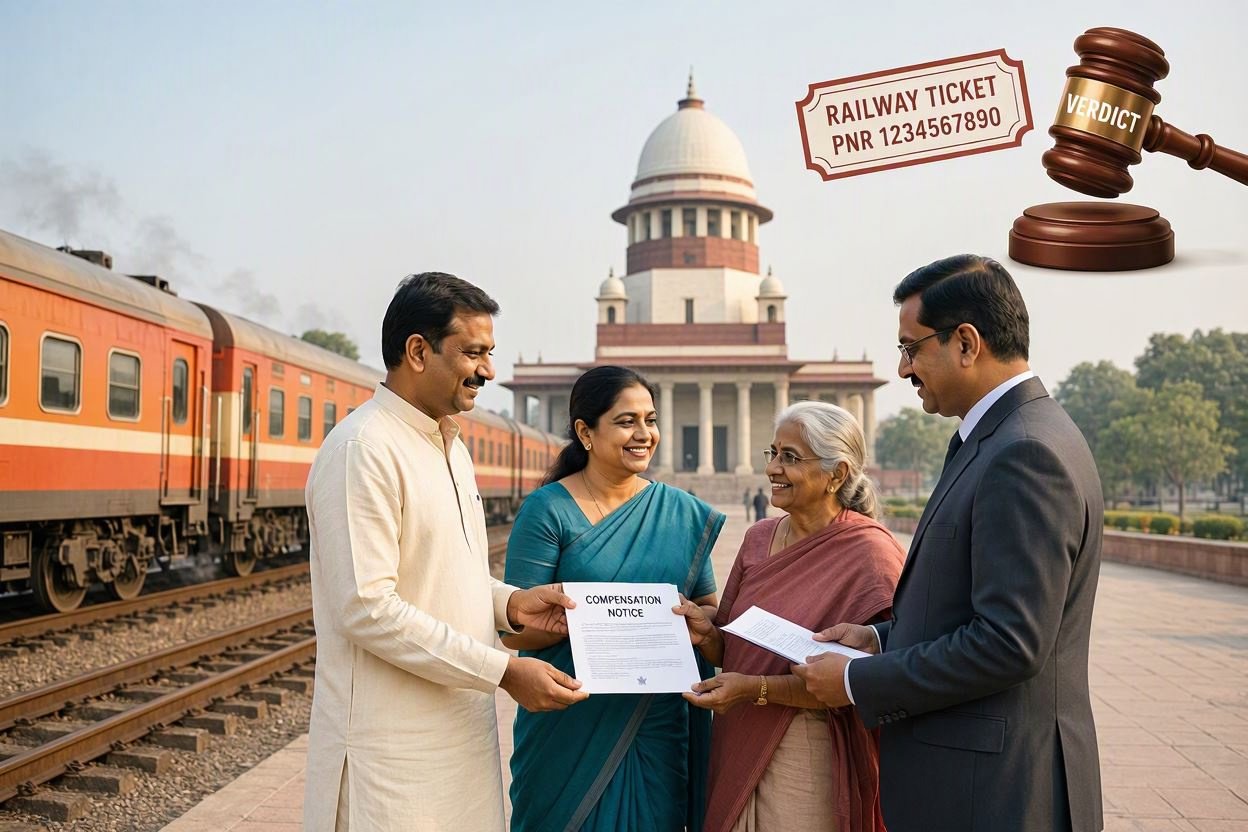
The Supreme Court has restored compensation of ₹8 lakh to the family of a railway accident victim, reaffirming that the absence of a train ticket by itself cannot be used to deny compensation when other evidence establishes that the deceased was a bona fide passenger.
The case arose from the death of a passenger who reportedly fell from a moving train. The claim for compensation was initially rejected on the ground that no train ticket was recovered from the deceased. The tribunal treated the absence of the ticket as a crucial factor against the claim.
On appeal, the Court examined the available evidence and observed that railway accident claims must be assessed in a practical and realistic manner. The Court noted that tickets can often be lost, destroyed, or become untraceable during accidents, and therefore their absence cannot automatically negate a compensation claim.
The Court emphasized that surrounding circumstances, witness statements, official records, and other corroborative materials may be relied upon to determine whether a victim was a bona fide passenger. It cautioned against adopting a hyper-technical approach that frustrates the beneficial object of the Railway Claims Tribunal framework.
Restoring the compensation, the Court directed payment of ₹8 lakh to the victim's family. The judgment reinforces the principle that railway accident compensation laws are welfare-oriented and should be interpreted in a manner that advances justice rather than defeating legitimate claims on technical grounds.
The ruling is expected to strengthen the rights of railway accident victims and their families by clarifying that compensation claims cannot be rejected solely because a physical train ticket is unavailable after an accident.