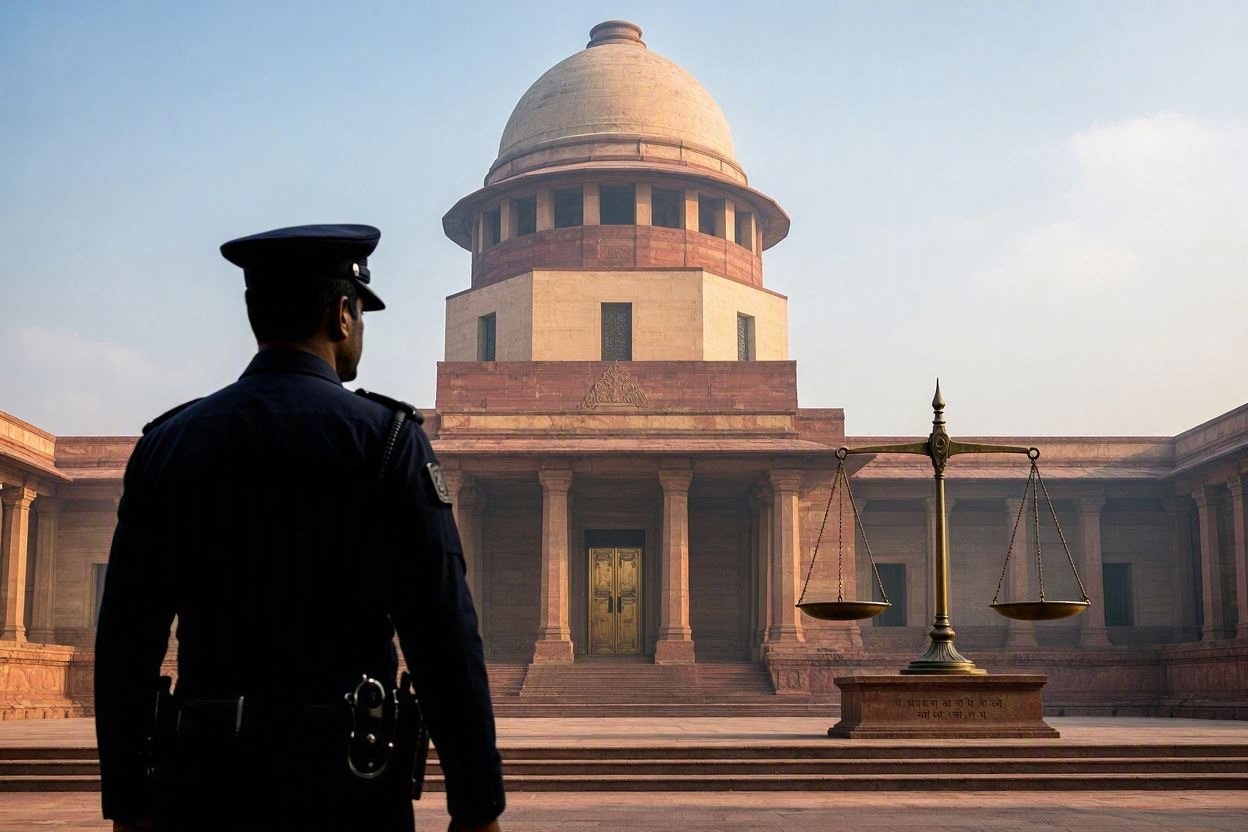
The Supreme Court of India has reinforced constitutional protections against arbitrary arrests by laying down strict safeguards governing illegal arrests and subsequent re-arrests. In a landmark judgment, the Court ruled that failure to provide written grounds of arrest renders the arrest unconstitutional and entitles the accused to immediate release.
A Bench comprising Justices Ujjal Bhuyan and Atul S. Chandurkar emphasized that the safeguards under Article 22 of the Constitution are fundamental and cannot be diluted, regardless of the seriousness of the offence alleged. The Court clarified that when a person is released due to violation of constitutional safeguards, such release is not equivalent to bail but rather a correction of unlawful detention.
To prevent misuse of power, the Court prescribed a structured procedure for re-arrest. Investigating authorities must first furnish written grounds of arrest and then seek permission from a Judicial Magistrate by filing a detailed application explaining the necessity of re-arrest and the reasons for the earlier constitutional violation.
The Court further directed that any application seeking re-arrest must be endorsed by a superior officer and that the investigation be transferred to another officer. A departmental inquiry must also be initiated against the officer responsible for the illegal arrest, with adverse findings potentially leading to disciplinary action.
Reaffirming the importance of personal liberty, the Court observed that constitutional safeguards apply equally to all offences, including those under special statutes. It also encouraged courts to award appropriate compensation in cases involving unconstitutional arrests.
The ruling is expected to strengthen procedural fairness in criminal investigations and enhance accountability within law enforcement agencies while ensuring greater protection of individual liberty.