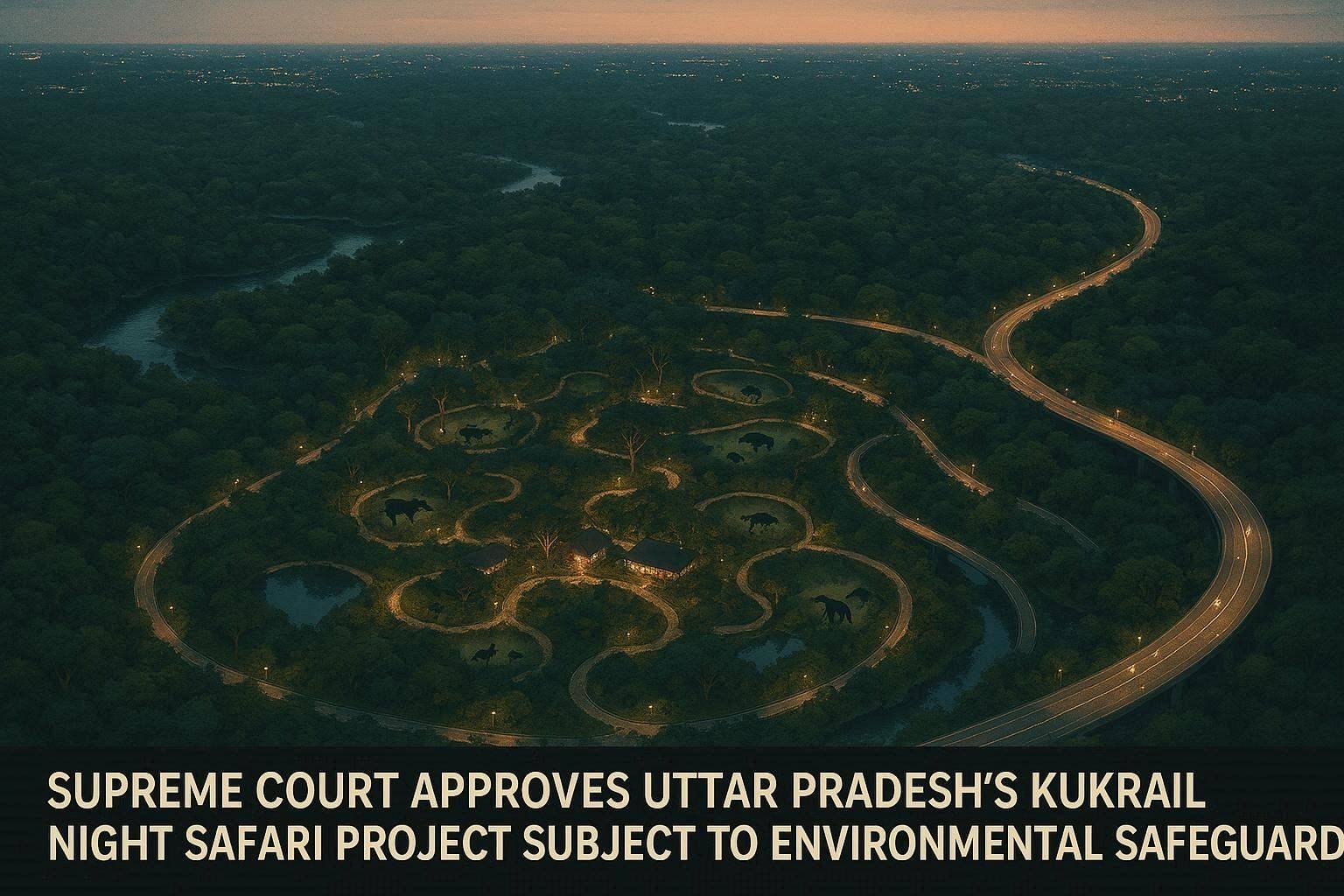
The Supreme Court of India has allowed the Uttar Pradesh Government to move forward with its proposed Kukrail Night Safari Project in the Kukrail Reserve Forest, Lucknow, while mandating strict adherence to environmental safeguards recommended by the Central Empowered Committee (CEC) and the Ministry of Environment, Forest and Climate Change (MoEFCC).
A Bench comprising Chief Justice of India Surya Kant and Justices Joymalya Bagchi and V. Mohana passed the order while hearing objections raised against the project. The Court noted that the CEC had submitted a comprehensive report recommending approval of the project subject to stringent conditions and that the State Government had agreed to comply with those requirements.
Accordingly, the Court permitted the project to proceed while directing a member of the CEC to periodically inspect the site and submit compliance reports. The first such report is to be filed within three months.
During the hearing, concerns were raised that the night safari would adversely affect the reserve forest ecosystem. However, the Court observed that expert bodies were better placed to assess environmental impacts and determine necessary safeguards. The Bench emphasized that development projects should not be halted when expert authorities have evaluated the proposal and prescribed protective measures.
The Court also took note of assurances regarding conservation measures, including the removal of invasive species and compliance with environmental norms. While allowing the project, the Bench underscored the importance of continuous monitoring and adherence to ecological safeguards.
The Kukrail Night Safari Project has been proposed as India's first night safari facility and forms part of a larger development plan in the Kukrail Reserve Forest area. The matter arose in proceedings connected to broader environmental litigation concerning forest conservation and the implementation of the Forest (Conservation) Amendment Act, 2023.
With the Supreme Court's approval, the Uttar Pradesh Government can now proceed with the project, subject to fulfilling all environmental and regulatory conditions imposed by the competent authorities.