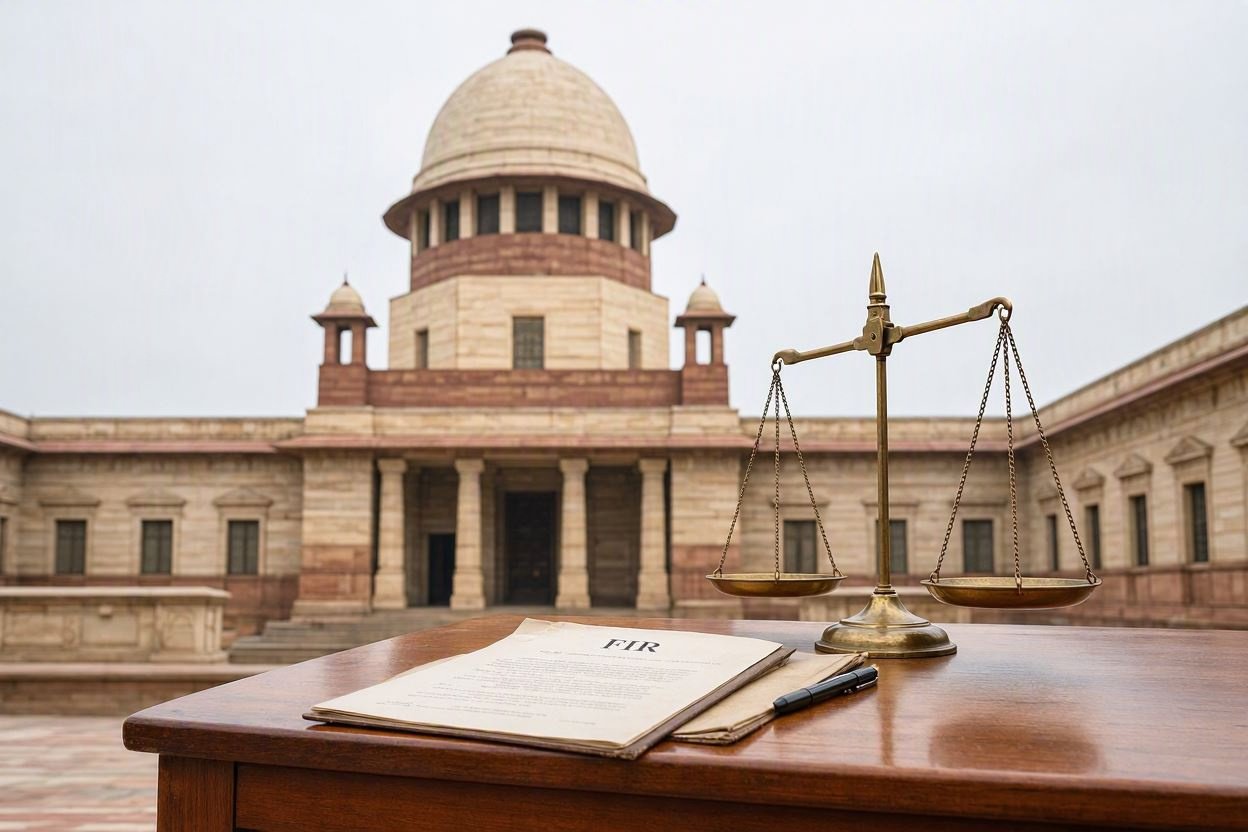
The right of an accused person to obtain a copy of a First Information Report (FIR) at the earliest stage of criminal proceedings has once again become a significant legal issue following recent observations by the Supreme Court.
The issue gained prominence after the Supreme Court directed the Ghaziabad Police to provide journalist Abhishek Upadhyay with a copy of the FIR registered against him and granted interim protection from coercive action. The Court's intervention highlighted an important gap in the Bharatiya Nagarik Suraksha Sanhita, 2023 (BNSS), which does not expressly provide an accused with immediate access to the FIR during the investigation stage.
Under Section 173(2) of the BNSS, a copy of the FIR must be supplied free of cost to the informant or victim. However, the statute does not explicitly provide a similar right to the accused at the investigation stage. Section 230 of the BNSS provides that the accused will receive copies of the FIR and prosecution documents after the filing of the police report before the Magistrate.
Despite the statutory silence, Indian courts have repeatedly recognized that an accused is entitled to access the FIR much earlier. In Youth Bar Association of India v. Union of India (2016), the Supreme Court held that an accused is entitled to obtain a copy of the FIR before the stage contemplated under Section 207 CrPC (now Section 230 BNSS). The Court further directed that FIRs should ordinarily be uploaded online within 24 hours of registration, except in sensitive cases such as sexual offences, POCSO matters, terrorism-related offences, and similar categories.
Earlier, the Delhi High Court in Court on its Own Motion v. State (2010) and the Himachal Pradesh High Court in Rama Nand Rathore v. State of Himachal Pradesh (2014) laid down mechanisms to ensure that accused persons can obtain FIR copies during the investigation stage.
The rationale behind these judicial directions is rooted in the principles of natural justice and personal liberty guaranteed under Articles 21 and 22 of the Constitution. Access to the FIR enables an accused person to seek anticipatory bail, challenge unlawful proceedings, move for quashing of criminal cases, and prepare an effective legal defence.
Legal experts have noted that although the BNSS represented a comprehensive overhaul of India's criminal procedure laws, it did not codify the judicially recognized right of early FIR access. Consequently, accused persons continue to rely on judicial precedents and court interventions to enforce this procedural safeguard.
The debate has renewed calls for legislative amendments to expressly incorporate the accused's right to receive a copy of the FIR at the earliest stage of investigation, thereby ensuring greater transparency, fairness, and protection of constitutional liberties within the criminal justice system.