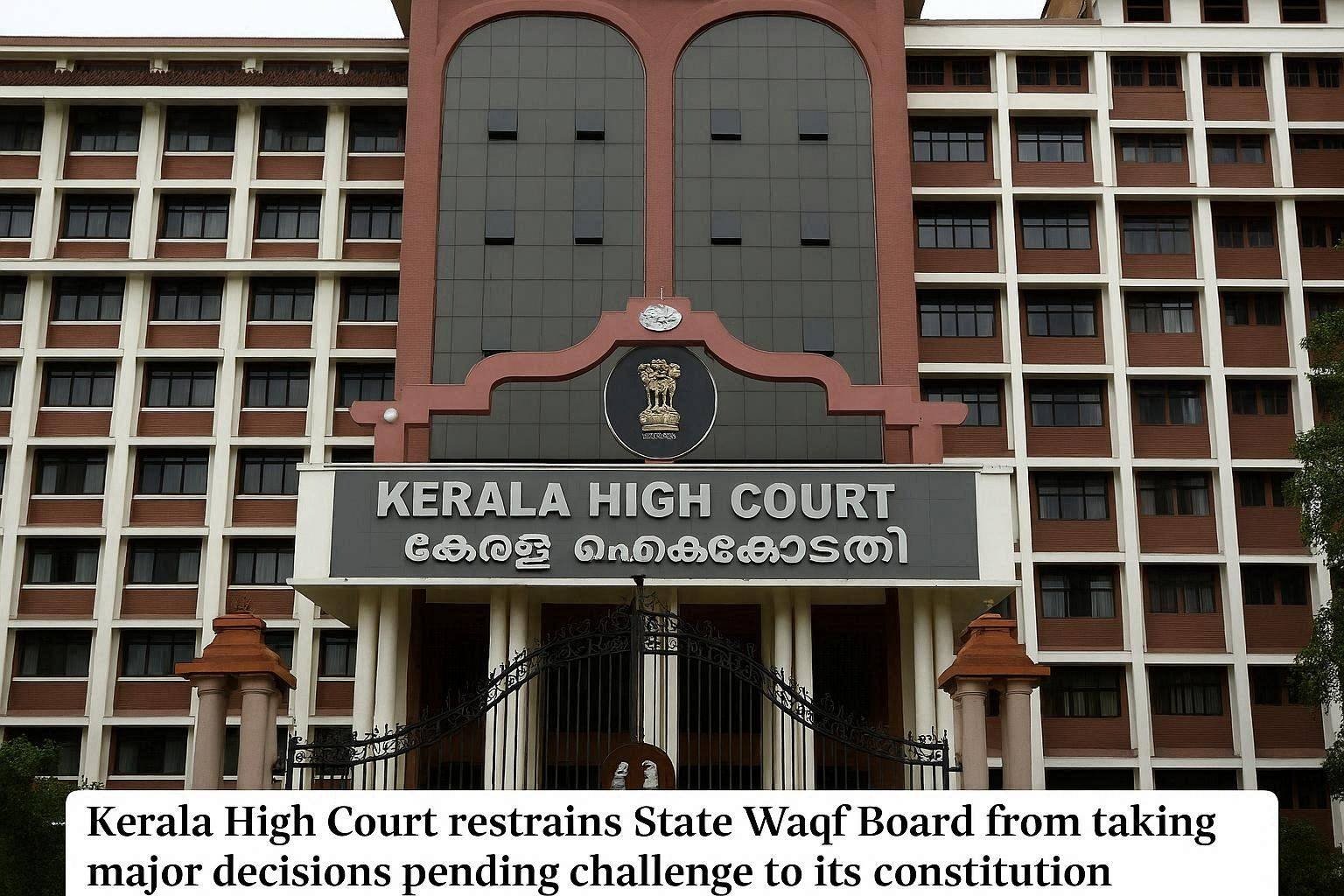
The Kerala High Court has directed the Kerala State Waqf Board not to take any major administrative or policy decisions until questions concerning the legality of its present constitution are adjudicated.
The interim order was passed while hearing a batch of Public Interest Litigations (PILs) challenging the composition of the Board under the Waqf (Amendment) Act, 2025. The petitioners contend that the Board has not been constituted in accordance with the amended statutory framework, which requires the inclusion of non-Muslim members.
A Division Bench of the High Court observed that, prima facie, the present composition of the Board appears inconsistent with the requirements prescribed under Section 14 of the amended Waqf law. In view of the legal challenge, the Court restrained the Board from taking major decisions that could have long-term administrative, financial, or governance implications.
The Court further directed that the functioning of the Board be supervised by the State Government's Joint Secretary handling Waqf affairs until further orders. However, the Board has not been barred from carrying out routine and day-to-day functions necessary for administration.
The dispute arises from multiple PILs filed before the High Court alleging that the Board is functioning without the mandatory representation contemplated under the amended legislation. Petitioners have argued that decisions taken by a Board constituted in violation of statutory requirements may be vulnerable to legal challenge.
The matter assumes significance in the backdrop of ongoing debates regarding the implementation of the Waqf (Amendment) Act, 2025 and the governance of Waqf institutions across the country. The High Court's interim order seeks to preserve the status quo while the legality of the Board's constitution is examined.
A detailed order is awaited. The case is expected to have wider implications for the interpretation and implementation of the amended Waqf framework and the validity of actions taken by statutory religious bodies that are alleged to be improperly constituted.