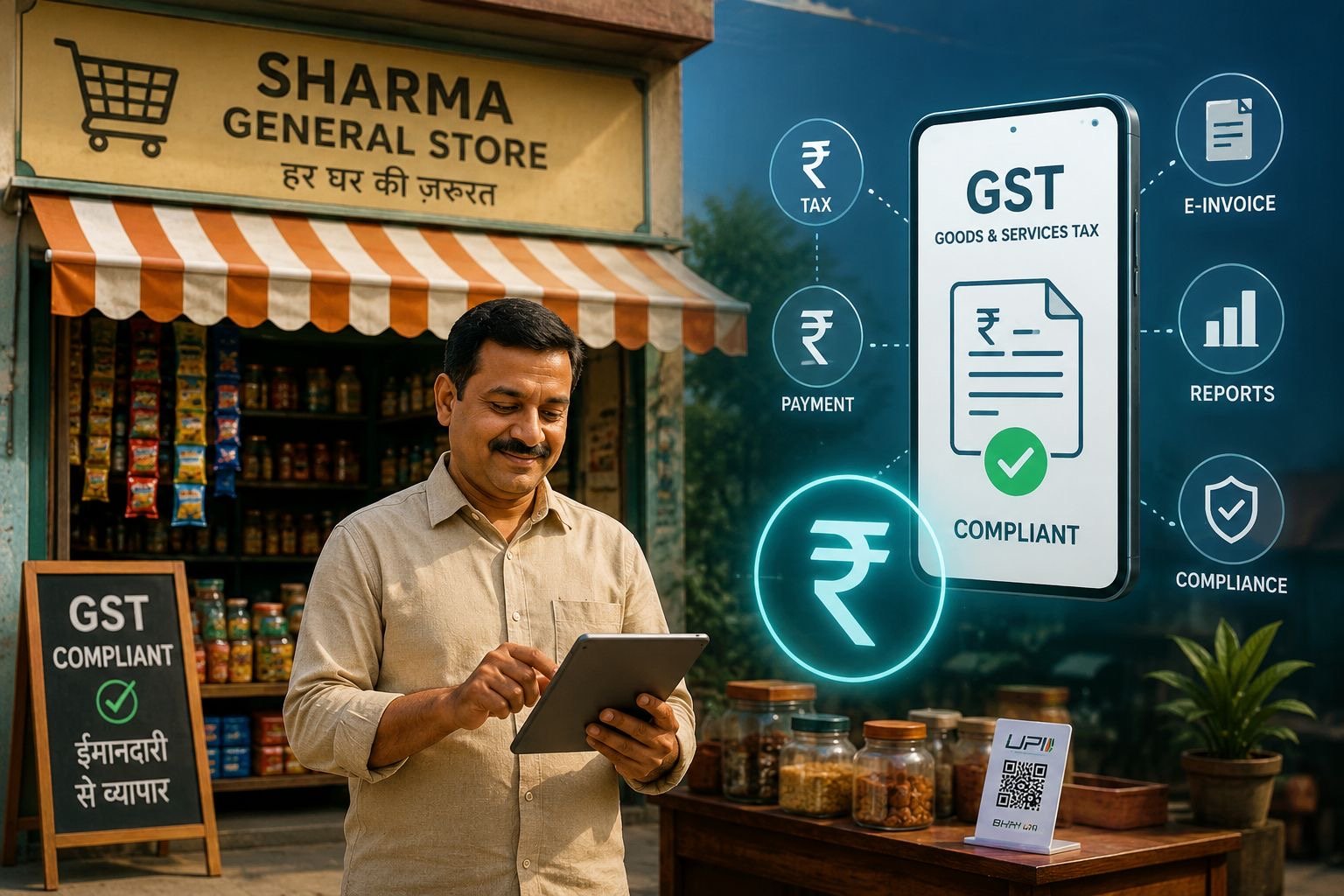
If you run a small business in India, chances are GST has crossed your mind at least once while raising an invoice or filing your taxes. For many first-time entrepreneurs, GST registration feels like one more government formality standing between them and actually running their business. But once you understand how it works, it stops feeling like a hurdle and starts feeling like a routine part of doing business — much like maintaining a bank account or renewing a trade licence.
What Is GST and Why Does It Matter for Small Businesses?
The Goods and Services Tax replaced a tangle of indirect taxes — VAT, service tax, excise duty — with a single, unified tax structure across India. For small businesses, this was meant to simplify things: one tax, one registration, one set of returns, instead of juggling multiple state and central tax regimes.
In practice, GST registration does more than keep you on the right side of the law. It makes your business look credible to vendors, banks, and larger clients who often insist on a valid GSTIN before discussing a purchase order. It also lets you claim input tax credit, which can genuinely reduce your overall tax outgo if you're buying raw materials, equipment, or services for your business.
Who Needs to Register for GST?
For most states, GST registration becomes mandatory once your annual turnover crosses:
- ₹40 lakh for goods suppliers
- ₹20 lakh for service providers
A handful of special category states have lower thresholds, so it's worth checking the limit specific to your state. Turnover isn't the only trigger, though. You need GST registration regardless of turnover if you:
- Sell through e-commerce platforms like Amazon or Flipkart
- Are involved in inter-state supply of goods
- Occasionally operate as a casual taxable person in another state for events or exhibitions
Even businesses below the threshold sometimes register voluntarily — a common move for small manufacturers or service providers who want to work with GST-registered clients, since many businesses prefer vendors who can pass on input tax credit.
The GST Registration Process, Step by Step
Registration happens online through the GST portal, and for most small businesses, it can be completed without ever visiting a government office.
Step 1 — Part A of the application: Fill in your PAN, mobile number, and email address to generate a Temporary Reference Number (TRN).
Step 2 — Part B of the application: Using the TRN, upload your supporting documents — proof of business address, bank account details, identity proof of the proprietor or partners, and photographs.
Step 3 — Processing: Once submitted, the application is usually processed within seven working days, though it can take longer if the officer raises a query or requests additional documents.
Step 4 — Receive your GSTIN: After approval, you receive a fifteen-digit GSTIN and a registration certificate to display at your place of business. This number must appear on every invoice, e-way bill, and GST return you file from that point on.
Quick tip: Keep your business address proof consistent across documents. Mismatches between your rent agreement, electricity bill, and application details are one of the most common reasons registration applications get delayed.
Choosing the Right GST Scheme
Not every small business needs to follow the same GST structure.
The Composition Scheme is worth considering if your turnover is under ₹1.5 crore (₹75 lakh for some special category states). It allows you to pay tax at a flat, lower rate and file quarterly returns instead of monthly ones — significantly reducing paperwork. The trade-off: you can't claim input tax credit and can't sell outside your state.
For businesses that deal in larger volumes, work with input tax credit, or supply across state lines, the regular scheme makes more sense despite the additional compliance it involves.
What Ongoing GST Compliance Looks Like
Registration is really just the starting point. For businesses under the regular scheme, ongoing compliance typically means:
- GSTR-1 — details of outward supplies, filed monthly
- GSTR-3B — summary return with tax payment, filed monthly
- GSTR-9 — annual return, filed once a year
Composition scheme taxpayers file a simpler quarterly return called CMP-08 along with an annual return.
Invoicing correctly matters as much as filing on time. Every GST invoice needs to include your GSTIN, the recipient's GSTIN if they're registered, the applicable tax rate, and a clear breakup of CGST, SGST, or IGST depending on the transaction. Getting this wrong doesn't just create accounting confusion — it can affect your customer's ability to claim input tax credit, which is the kind of thing that quietly damages business relationships.
Late filing carries its own costs. Interest is charged on unpaid tax, and late fees apply per day of delay — so even a return with zero tax liability needs to be filed on time to avoid penalties.
Common Mistakes Small Businesses Make
- Missing filing deadlines during a busy season
- Mismatched invoice details between GSTR-1 and GSTR-3B
- Forgetting to reconcile input tax credit against GSTR-2B
- Using the wrong tax rate for a product or service category
- Failing to update registration details when business address, bank account, or authorised signatory changes
The GST portal allows amendments — keeping this information current avoids complications during audits or when applying for loans.
Making GST Compliance Manageable
The easiest way to stay compliant as a small business is to build a simple monthly routine: reconcile your sales and purchase invoices, check your input tax credit against GSTR-2B, and file returns a few days before the deadline rather than on the last day. Many small businesses also find it worthwhile to use accounting software that auto-generates GST-compliant invoices and return data, removing the manual errors that creep in with spreadsheets.
If your transactions are relatively straightforward, you may be able to manage GST compliance in-house. But as your business grows and your supply chain becomes more complex, working with a chartered accountant or GST practitioner often pays for itself in the time and penalties it saves.
Final Thoughts
GST registration and compliance follow a fairly predictable rhythm once you get into it. Register when you're required to, choose the scheme that fits your business model, invoice correctly, and file on time. Do that consistently, and GST becomes just another part of running your business — not an obstacle to it.